
News
-
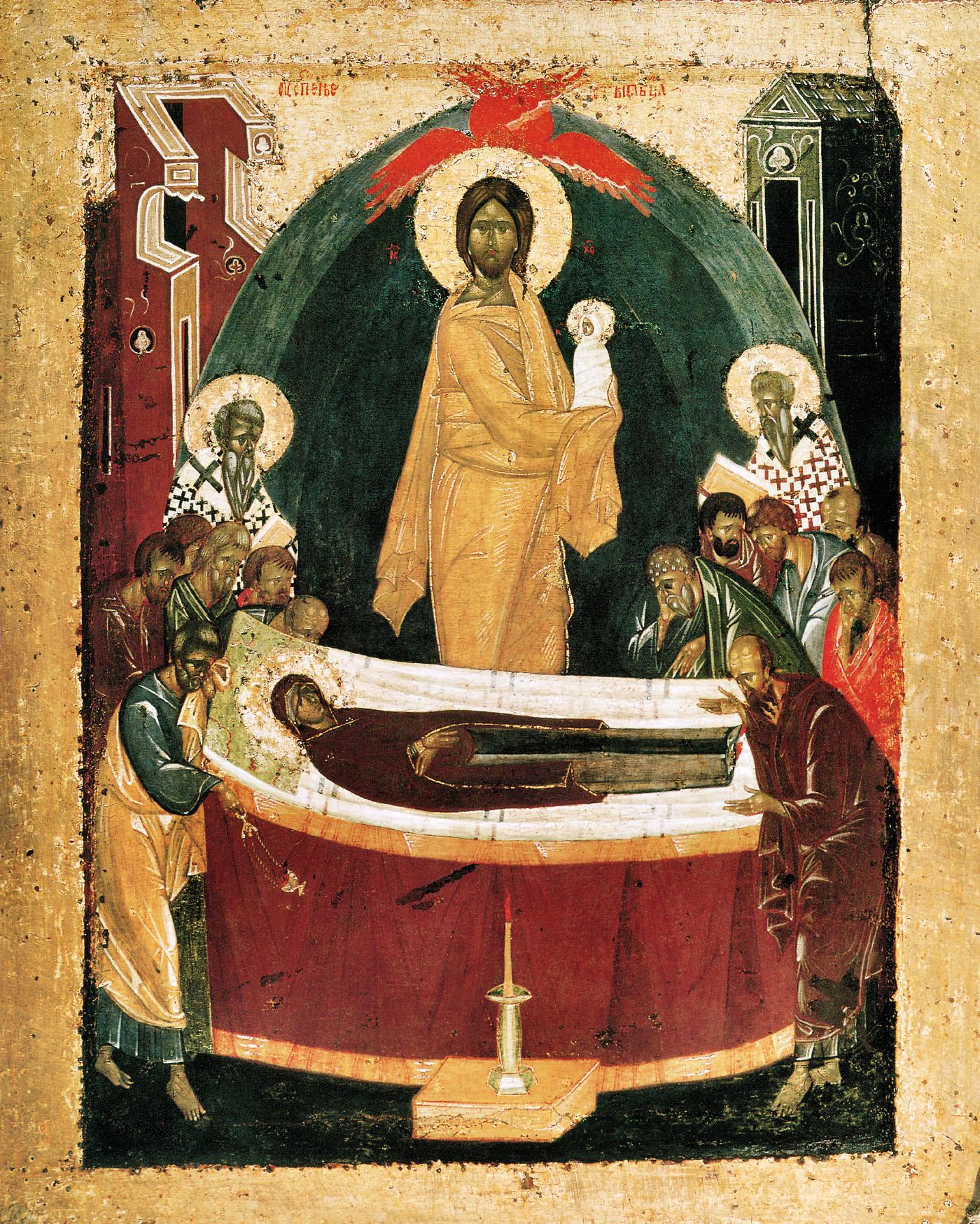
15/28 August – Dormition of our Most Holy Glorious Lady Theotokos and Ever-Virgin Mary
11:30 AM
After the Ascension of the Lord, the Mother of God was in the care of St. John the Theologian, and in his absence, she lived in the house of his parents near the Mount of Olives. She was a consolation and edification for the apostles and all the faithful. Talking with them, the Mother of God related the wonderful events of the Annunciation, seedless conception and Her giving birth without corruption to Christ, His infancy and entire life on earth. Like the apostles, She planted and confirmed the Christian Church by Her presence, word and prayers. The reverence of the apostles toward the Most Holy Virgin was extraordinary. After receiving the Holy Spirit on the significant day of Pentecost, they continued in Jerusalem for about ten years, ministering toward the salvation of the jews and wishing more often to see and hear from Her Divine words. Many from among the newly illumined by the faith came even from distant lands into Jerusalem in order to see and hear the Most Pure Theotokos.
During Herod’s persecution of the young Church of Christ (Acts 12:1-3), the Most Holy Virgin Mary, together with the apostles John the Theologian, in the year 43, went to Ephesus, where it was his lot to preach the Gospel. She also visited St. Lazarus the Four-days-dead on Cyprus, he was the bishop there, she went to Mount Athos, of which, according to St. Stephen of the Holy Mountain, the Mother of God said prophetically: “This place shall be my lot, given Me by My Son and My God. I shall be the Protectress of this place and the Intercessor for it.”
The circumstances of the falling asleep of the Mother of God are known in the Orthodox Church from apostolic times. In the first century, hieromartyr Dionysius the Areopagite wrote about Her Dormition. In the second century, narrative about the bodily translation of the Most Holy Virgin Mary to Heaven is found in the works of Meliton, bishop of Sardis. In the fourth century, St. Epiphanius of Cyprus points to the tradition regarding the Dormition of the Mother of God. In the fifth century, St. Juvenal, Patriarch of Jerusalem, said to the holy right-believing greek queen Pulcheria: “Even though Sacred Scriptures do not contain information about the circumstances regarding Her falling asleep, we know of them from the most ancient and most sure tradition.” This tradition is carefully collected and presented in the church history of Nicephorus Callistus in the fourteenth century.
Evidence remains that at the end of the seventh century there existed a church over the underground church of the Dormition of the Most Holy Theotokos; from this church’s bell tower one could see the dome of the church of the Resurrection of the Lord. There are no traces of this church now. However, despite the destruction and changes, the general primary crosswise foundation of the church remains.
“It is necessary for that, which was formed of earth, and was going to return to earth, and then would ascend to heaven, having received in the earth the most pure life through the leaving of the flesh in it; it is necessary for the body through death, as though through the fire in the furnace, just like gold, having been cleansed of all darkness and the crude heaviness of corruption, to rise from the tomb incorrupt, pure and illumined with the light of immortality.” – These words belong to St. John of Damascus. On the feast of Dormition in the year 754, the saint delivered a homily in Jerusalem – over the Tomb of the Most Pure One, Who asked to be buried in Gethsemane, at the foot of the mount of Olives, not far from the place, where the last night in the earthly life of Her Son was spent.
According to the testimony of the byzantine church historian George Kedrin, the falling asleep of the Theotokos was preceded by a manner of second Annunciation: “the Most Holy Virgin, once, was praying on Her knees at the very place, where Her Divine Son once prayed about the cup, when, suddenly, Archangel Gabriel stood before Her, and giving Her the sign of victory over bodily death – a branch from the date palm in paradise – he announced to Her that She would fall asleep in three days.” George Kedrin writes that the apostle John the Theologian carried this branch before the bier of the Theotokos after Her Dormition.
The circumstances of the falling asleep of the Theotokos, as well as all related to Her, are set forth in the work of some Leucius, a younger contemporary of the apostles. This work is very ancient and is dated in the beginning of the second century of christian era; its content fully agrees with the orthodox service for Dormition. According to Leucius, the adopted son of the Most Pure apostle John and the first bishop of Jerusalem Jacob the brother of the Lord informed all the faithful about the coming Dormition of the Mother of God. Apostles, in wondrous manner, were brought from various regions into the Holy City of Jerusalem. Only apostle Thomas, by a special providence of God, was unable to bid farewell to the Mother of the Savior. Further, it is noted that the Theotokos was buried at the Gethsemane cemetery, near the valley of Jehosophat, near the graves of her parents: Ss. Joachim and Anna, in one of the three tombs in that section of the cemetery, the one closest to the east.
In 1972, archeologist and famous specialist in early christians monuments, franciscan Bellarmino Bagatti had the honor of confirming the absolute exactness of the topographical data of Leucius. A flood helped the discovery: in 1972 the underground church of the Dormition of the Mother of God was flooded more than usual. “Misfortunes often happen to be providential, – is written in the report of the monk professor. – In the past, when our Sister the Water finished its veneration at the holy place, the custodians, armenians and greeks, changed the vestments in the church and as soon as the walls were somewhat dry, painted them anew. However, this time it was decided to do a more thorough job. When the plaster fell, the stone wall of the burial chamber of the Virgin Mary stood before our eyes.”
Forty eight steps of the wide stone stairway, literally overflowing with a hot river of wax, made from the thousands of melted candles, on the days of Dormition, lead into the underground church. In the fifth century, over the tomb of the Ever-Virgin cut in stone, there stood a richly decorated byzantine style church, and there were only twenty steps, but since then, or more precisely from the time of the crusaders, the ground level changed and the Dormition church, one might say, went deeper into the rocky soil.
Three days before Dormition the orthodox clergy of Jerusalem transfers a silver Shroud into Gethsemane – in memory of the sad day, when the apostles carried the Most Pure body of the Theotokos from the house of apostle John on mount Sion. By the way, in a calendar, compiled before the time of the crusades in Jerusalem, there is the feast of “translation of the Body of Mary from mount Sion to Gethsemane.” On the 14th of August according to Church calendar, one day before the feast, Patriarch of Jerusalem and all the brotherhood of the Holy Tomb walk along the way of the Cross in the direction of the gates of Saint Stephen (they are also known as the Lion’s gates, and the Gates of Lady Mary). A small distance from them, beyond the Kedron valley, is situated the church of Dormition – the tomb of the Most Holy Theotokos.
…On the third day after the Dormition of the Theotokos the unconsolable apostle Thomas came to Gethsemane, and weeping, he bowed over the cave of the tomb. Having compassion for his sorrow, the other disciples agreed to move away the stone, which covered the entry into the tomb, however, the Most Pure Body was no longer there, for the Most Holy Theotokos “as though with sleep slept for a short while in death, she soon as from sleep, woke from it, and having shaken off the deadness of the tomb, as sleep from eyes, she saw the immortal life and glory in the light of the Countenance of the Lord” (from the canon of Dormition).
-
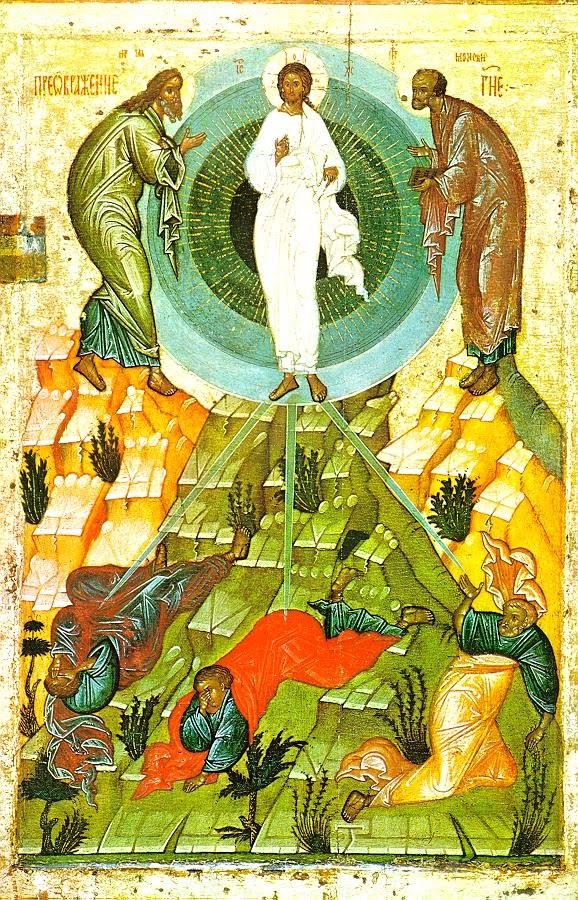
August 6/19 – Holy Transfiguration of our Lord God and Savior Jesus Christ… Second (“Apple”) feast of the Savior
12:01 AM
In the Transfiguration of the Lord the mystical Divine essence of the One, Who was still called Nazarene, suddenly became visible to the three disciples chosen by Himself, or, in the language of the Church, this Essence proceeded through the human nature of Jesus. Apostles Peter, James and John saw the Son, Whose image shown “like the sun.” At the same time, the Apostles physically experienced upon themselves “the grace of the Holy Spirit, coming, like a noetic light, brining joy” (according to the words of St. Symeon the New Theologian). And when Peter, for a moment being permeated by this Light, cried out: “Lord! It is good for us to be here,” the voice of the Heavenly Father: “This is My beloved Son, in Whom I am well pleased; hear ye Him” (Matthew 17:4) became audible for him, and for James and John.
The author of the Third Gospel, holy apostle Luke, in his description of the Transfiguration offers three most important details: the Lord’s “appearance of countenance” changed during the time of prayer; Prophets Moses and Elias spoke with Jesus “about His departure, which He had to accomplish in Jerusalem” (Luke 9:31); the disciples “were heavy with sleep” and that in some way foretold the unconquerable black sleepiness, that would soon come upon the apostles in the garden of Gethsemane at night.
Transfiguration of the Lord happened on the eve of the Old Testament feast of tabernacles, which is called “the feast of our joy,” “the feast of light” and other. During these days, according to ancient custom, the faithful had to dwell in houses made of branches – “tabernacles,” – which in part signified the corruptibility, instability, and temporary nature of all things earthly. However, at the same time the feast of Tabernacles is also the end of the difficult labor of cultivating the land for months, it is the gathering of the harvest.
“…if Thou willest, let us make three tabernacles here: one for Thee, one for Moses, and one for Elias, – Peter offered the Lord, “for he did not know what to say; for they were sore afraid” (Mark 9:6). According to Bishop Cassian (Bezobrazov), Peter thus tried to hold Transfiguration: for if Christ, the Son of the Living God, is near, and Moses, and Elias, who embody the Law of God and the Prophets, then, it must be that the Kingdom of God “is at the doors”: it either came already, or will come at any moment, and one would not have to go into cruel stone Jerusalem, above which hangs the red hot haze, and one could stay here, in the green, blossoming Galilee, on mount Tabor…
The Church tradition, rising at least to the third century A.D., points to mount Tabor, in the southern part of Galilee, as to the place of the Transfiguration of the Lord.
“Mount Tabor is earthly heaven, exultation of the soul and satiation of the eyes of the orthodox: for some divine grace is present, overshadowing the mountain, which is what inspires the spiritual joy,” – sometime wrote the greek from Crete, author of pilgrim’s notes, John Fokas; his visitation of the Holy Places of Palestine happened in 1187. It is difficult to say what exactly he saw on mount Tabor: some sources state that in 1181 the armies of calif Saladin destroyed the local monasteries and churches, killed those, who lived there, and upon the ruins they built a fortress to deflect the attacks of the crusaders.
The glorious “igumen of the Russian land” Daniel mentions the churches on Tabor in his “Pilgrimage”: “There is a place at the very top of the mountain, as though a stone hill, small, with a sharp top, upon that place Christ our God was Transfigured; there are good churches built there, one in honor of Transfiguration, and the other in honor of the holy prophets Moses and Elias.”
All of this, later on, disappeared at the hands of the destroyers, and only in the XIX century, greek orthodox church was built on Tabor, where one can see the remains of the buildings from the times of the holy Empress Helena, mother of holy Equal-to-the-apostles Emperor Constantine. The guide for the Russsian pilgrims, published in 1894 in Odessa, narrates: “Pilgrims take almost an hour in order to climb to the sacred top of the mountain of Transfiguration. At the walls of the greek monastery the caravan is greeted by the peeling of the bells and the pilgrims go straight into the church… Having venerated at the holy place, the pilgrims situate themselves within the walls of the monastery, however each one is capable. The entire building of the monastery, even the church is wide open to receive the distant travelers. In the evening, our Russian hieromonks, along with the entire brethren of Tabor, clergy from among the pilgrims, and in the presence of the Metropolitan [of Nazareth], serve the all-night vigil, and then, early in the morning, liturgy in Church Slavonic.”
The shining of the uncreated light of Tabor right next to sinful people, who were sleeping, contains within itself a promise: “it is impossible for Him not to enlighten those, who in a worthy manner participate in the Divine shining of His Body within us,” – writes St. Gregory Palamas. It was in this very manner that the blessed Batushka Seraphim of Sarov made his N.A. Motovilov a seer of the mystery and fellow participant of being in the Light of Transfiguration. “Imagine to yourself, in the middle of the sun, in the very shining brightness of its noon rays, the face of a man, who is talking to you. You see the moving of his lips, the changing expression of his eyes, hear his voice, yet you do not see yourself, nor his figure, but only the blinding light, stretching far, and illumining with its bight shining the snow, covering the meadow, and the pieces of snow, pouring from above upon me and upon the Great Elder”, – said Motovilov about what took place.
In continuation of the Old Testament custom, the fruits of the earth are blessed on Transfiguration, the heads of wheat and grapes, “for from it there comes wine, acceptable for the offering of the bloodless sacrifice”.
-
-
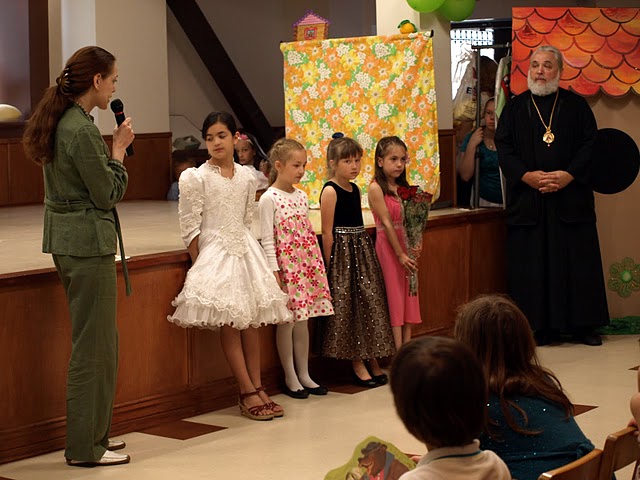
On Saturday, 18 June, the annual graduation at the Church Parish School of A.S. Pushkin, was held at the St. Nicholas cathedral in Montreal
09:59 AM
On Saturday, 18 June, the annual graduation at the Church Parish School of A.S. Pushkin, which exists at the parish since 1937, was held at St. Nicholas cathedral in Montreal in order to mark the ending of the school year.
A solemn prayer service for the occasion was conducted by His Eminence, the Very Most Reverend Gabriel, Archbishop of Montreal and Canada. Vladyka Gabriel, being the principal of the parish school at his cathedral, pays much attention to orthodox upbringing and education. Addressing the parents, teachers, and all those present, His Eminence, Archbishop Gabriel, in particular, noted that care for orthodox parish schools is the primary task of every parish in the Russian Diaspora, because in case of neglect, our parishes will face gradual extinction. Vladyka called upon the parents to do everything possible in order to make sure the children do not lose the connection with their native language and the great culture of Historical Russia. Vladyka also expressed the hope that the number of students at the cathedral parish school – where there are more than 70 students of different ages currently – will continue to grow with each year.
After the prayer service, students received certificates and awards, then there was a concert.
After the concert, everyone was invited to a traditional meal.
Here are the photos from the event, prepared by the teacher of Russian history and Church Slavonic language, E.M. Bormotova.
-

FOR THE DAY OF THE HOLY TRINITY
12:42 AM
Three times in the history of our salvation the Third Hypostasis of God – the Holy Spirit – visibly, audibly, and palpably manifested Itself “Who with the Father and the Son together is worshipped and glorified,” for the old testament world knew always the Holy Spirit “Who spoke by the prophets”: He was “in every pure soul, without Him no truly good work was ever completed” (Bishop Innocent of Kherson). The Holy Spirit invisibly dwelt in the Holy of Holies of the Jerusalem temple, but He departed when the Lord “gave up the spirit” on the Cross; as the mark of departure and the harbinger of the destruction of Jerusalem served the great sign: “…the veil of the temple [separating the Holy of Holies – YM] was rent in two, from the top to the bottom” (Matthew 16:37-38). It is essential that the description of this event we find not only in the Gospels, but also in the judean records, where a fairly exact date of what happenned is also given as the forty years before the destruction of the temple, i.e. in the 30th year after the Nativity of Christ, in the year of crucifixion.
The fullness of the Trinity was given to us in Theophany (Baptism of the Lord) at the Jordan; later on the Holy Spirit illumined the apostles with the uncreated light of Tabor in the miracle of Transfiguration; and, finally, “bestowing the tongues of fire, He called all into unity” in the Upper Room on Sion on the day of Pentecost.
Yet the very ability of men to receive the gifts of the Holy Spirit possesses as its source the meeting of the Life-creating Trinity in the image of Three Travelers by forefather Abraham, the friend of God.
“And the Lord appeared unto him in the plains of Mamre: and he sat in the tent door in the heat of the day; And he lifted up his eyes and looked, and, lo, three men stood by him: and when he saw them, he ran to meet them from the tent door, and bowed himself toward the ground, And said, My Lord, if now I have found favour in thy sight, pass not away, I pray thee, from thy servant” (Genesis 18:1-3).
As it follows from the Scriptures, the Friend of God addressed the Three Men in singular person.
The Mamre oak grove was situated on the slopes of the hollow to the west of Hebron of those days. The Oak of Mamre (in other words Abraham’s), under the shade of which the forefather received the Mystical Guests, survived miraculously to our days, having given life to multiple shoots.
“Old, very old is this Patriarch of the vanished forests of Palestine, – is said in the travelling notes of the famous Russian explorer and ethnographer A.V. Eliseev (With the Russian pilgrims to the Holy Land in the spring of 1884, St. Petersburg, 1885). – Many parts of it have dried, but it still lives, and though not every year, but does bear fruit… The venerable oak, according to my most thorough calculations, is in no way less than 4 to 5 thousand years old, judging by the number of the lairs of its triple and quadruple branches, the cuts of which I was able to observe.”
Christian writers of the XVII century mention the Oak of Abraham in their “travels,” it is notable that the location pointed out by them then matches exactly the current location of the tree.
The famous igumen Daniel, who visited the Holy Land during the time of the Jerusalem’s king Baldwin I, tells: “And from Bethlehem, facing south is Hebron, the cave of Abraham and the oak of Mamre. …The oak is close to the way, there walking on the right hand side; and it stands beautiful on the high mountain. …And here stood the tent of Abraham near the oak, facing east. And the oak is not very tall, spread out and is thick with branches, and there is much fruit on it.”
The piece of land, upon which the Oak of Mamre grew, was – together with the other most important parcels on the Holy Land – purchased for the Russian ownership by the ever-memorable archimandrite Antonin (Kapustin) – the director of the Russian Spiritual Mission.
The parcel “Khirbet-en-zibta,” pointed out by tradition as the biblical grove of Mamre, used to belong to the family of some Ibrahim Shalludi. The history of the purchase of the Oak deserves a more thorough look at it.
Only the subjects of the Ottoman empire were allowed to buy land openly in these regions. It was here that sometime famous mission translator Iakov Yegorovitch Khalebi played his role.
Iakov Yegorovitch adorned my live, – Fr. Antonin Kapustin, not inclined to emotional exclamations, spoke of him.
“In the winter of 1868, he [Khalebi – YM] appeared in Hebron under the guise of a merchant from Aleppo. Iakov Yegorovitch, carefully playing his role, as though buying merchandise, mingling in the midst of Hebron merchants, spent a long time there. Finally, after long and fatigueing negotiations, combinations, precautions, countless bribes, Shalludi sold the parcel with the Oak to Iakov Yegorovitch, a lawful ownership deed being drawn up for the transaction.
I had to hear about his meeting with Fr. Antonin in Jerusalem form eyewitnesses. Fr. archimandrite waited for Khalebi, who arrived, at the entrance into a hall, on the stairway, in the Mission building. As soon as Iakov Yegorovitch, still from below, saw the figure of Fr. Antonin, he joyously ran up the stairs, waving the deed and shouting: ‘the Oak is Russian, the Oak is Russian!’ Fr. Antonin joyously opened his embrace to him and kissed him.” (Archimandrite Cyprian Kern. Fr. Antonin Kapustin. Belgrade, 1934).
On 22 May, 1871, at the Oak of Mamre first Liturgy was served, and to this day, on the third day of the feast of Pentecost, the clergy of the Mission serves Liturgy upon a movable altar table under the tree, from which all of our trinity birches take our beginning.
The buiding of the large church with three altars dedicated to the holy Forefathers was started only in 1907, while archimandrite Leonid (Sentsov) was the director of the Mission. The work was completed only in 1925.
“It is easy to reestablish how the travellers journeyed, – says a guide “Holy Land” (Paris, 1960). – Most likely, they descended into the Hebron Valley from the Northwest, and Abraham, who sat in the shadow of his tent in the midday heat, saw them on the slope of the mountain, where there now stand Russian cathedral and a house for pilgrims.”
-
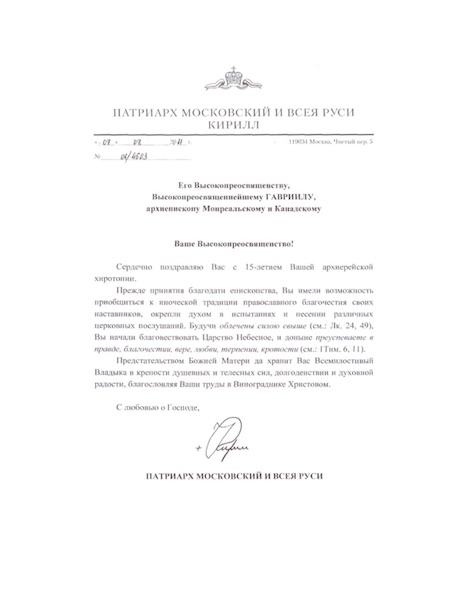
Patriarch’s greeting of archbishop of Montreal Gabriel on his 50th birthday
11:58 AM
His Holiness, Patriarch of Moscow and All Russia Kyrill congratulated archbishop Gabriel of Montreal and Canada with his 50th birthday.
To The Very Most Reverend Gabriel, archbishop of Montreal and Canada
Your Eminence!
I congratulate you with your jubilee heartily.
During the years of your zealous ministry for the good of the Church of Christ, you, by the mercy of God, had an opportunity to fulfill many obediences, showing an example of humble and meek fulfillment of the Lord’s will and the decisions of the Hierarchy. Having been raised in the best traditions of the Holy Trinity Seminary in Jordanville, you dedicated a significant portion of your life to teaching in this famous centre of orthodox spiritual education.
By the most wise Providence of the Master of the world, you soon became a successor to the apostles, “as good steward of the manifold grace of God” (1 Peter 4:10). Now you administer the Diocese of Montreal and Canada, bearing witness to the truth and beauty of the orthodox faith, “warning every man, and teaching every man in all wisdom; that we may present every man perfect in Christ Jesus” (Col. 1:28).
In attention to your diligent labours and to the significant jubilee celebrated by you I consider it proper to award you with the medal of St. Sergius of Radonezh, of the II degree.
By the intercessions of the Heavenly Mistress, may the All-mercifull Saviour keep you in good health and good spirit for many and good years, giving you the strength for the carrying out of the responsibility of hierarchical ministry.
With love in the Lord
+KYRILL, PATRIARCH OF MOSCOW AND ALL RUSSIA
The clergy and faithful of the Canadian diocese, with spiritual joy join the congratulations and good wishes, expressed in the letter of His Holiness, Kirill Patriarch of Moscow and All Russia, addressed to our Hierarch, the Very Most Reverend Archbishop Gabriel.
Many and good years, dear Vladyka
-

FROM THE DIOCESAN ADMINISTRATION To all parishioners of the Resurrection church in Toronto, Ontario
11:50 PM
Beloved in the Lord brothers and sisters!
Christ is Risen!
In these days, when we still greet each other with a Paschal greeting, preparing for the approaching Feast of the Holy and Life-creating Trinity, we are in need of addressing you with this letter. Sorrow has visited your parish: you are being drawn into a schism. Now we must make efforts so that the Risen Savior in His mercy would pity us and give us the strength and fortitude to overcome the disorder at hand.
First, we would like to bring to your knowledge the documents, which – as we are informed – were not known to the majority of the parishioners, but only to a small group of people, striving for the right to administer the future of your parish, as well as all the Church property, without any supervision.
That is why it is especially important that each of you were given the unimpeded opportunity to know the very reason for the current state of affairs.
It is possible that the majority of the parishioners are not aware that the former parish rector, priest George Sachewski, broke all ties with his diocese, his Hierarch and his clergy brothers, long time ago. Therefore, after many attempts to clarify things with priest George, on 9/22 March, of this year, the Very Most Reverend Gabriel, Archbishop of Montreal and Canada, addressed to him the following letter, which stated:
“As your ruling Hierarch, I am pressed by necessity to address you with this letter, since all my efforts to correct you in private conversations, regretfully, did not bring any desired results. Among other things, we don’t even have an opportunity to meet with you very often… Demonstratively, you refuse to participate in Diocesan Great Lenten retreats, in Diocesan assemblies. You did not even grace us with a response to our directive, inviting you and your parish to attend the solemn celebration of the 90th anniversary of our Russian Church Abroad.
To add to the previously stated, you do not send the proper contributions into the Diocesan treasury, and did not pay attention to the circular directive, according to which all our parishes must purchase candles from the Diocese, a fact of which you cannot be ignorant.
/…/ I shall not quote the suitable paragraphs of the Book of Rules because I am convinced: You yourself know that we are speaking of disorder and even consciously vexing the Bishop. Such behavior is a bad example to our clergy and cannot be tolerated any longer.
Yet, what was it and what is it now that prohibits you from contacting me and telling me the reasons for the restless state of your spirit? Whence is this hostile irritability, which has engulfed you?
For the last time, I call upon you to come to your senses, to find a return to participation in the life of the Diocese. That will help you find peace of soul, which is so important during the saving days of Great Lent.
However, should you continue to be stubborn in your disobedience, I shall have nothing other to do, but to remove you from your post of rector in our Resurrection parish.
With hope for your speedy recollection, prayerfully, I wish you help and direction from the Lord.”
There was no answer, neither verbal, nor written, to this letter.
Only then, after the passing of almost one and a half months, the Very Most Reverend Gabriel was urged by his duty to take action. Notably, he used only administrative measures, which do not involve Church discipline.
24 April/7 May, 2011, there was a directive, which priest George received the following day. Here are the main points:
“It is with great sadness of soul that I was forced to acknowledge the fact that all my attempts to call you to mind, to incline you to reestablish the ties you demonstratively broke with your Diocese, your fellow brothers the clergy, and finally, with me, your Hierarch, did not lead to desired results. You did not bother to reply to my corrective letter, mailed to you in the end of March, at the address of your Resurrection church. There was not even any attempt on your part to explain to me: what was it that caused your persistent lack of desire at least to discuss your situation with your Bishop.
Such conduct of a clergyman is an obvious vexing of one’s Bishop, of which we are warned by the 14th Rule of the Twofold Council.
Based on this, and equally using the right given to me according to the Paragraph 47, point “b” of the Regulations of ROCOR, hoping for your return to right reason, I relieve you of your position as rector of the Holy Resurrection parish, on Winona (Toronto, Ontario), and transfer you to the same position of rector at the Protection parish in Hamilton (Ontario). Perhaps, at the new place you will be able to come to recollection sooner.
You must, without delay, contact Fr. Protopriest Michael Luboshchinskiy, who is appointed rector of the Resurrection parish on Winona, and discuss with him the order of the named transition in order for the established divine services to continue uninterrupted in both churches.
Should this also not avail, regretfully, I will have to use the discipline set forth in the Holy Canons.
To this end you are given this directive.
This directive comes into effect from 26 April/9 May, 2011.”
Notwithstanding, Archbishop Gabriel, taking into consideration the feelings of the flock of the Resurrection church, on 28 April/11 May, 2011, published a special explanation to his directive:
“…I inform you that you are permitted to serve on Sunday, 2/15 May, in the Resurrection church on Winona, Toronto, Ontario, in order to say farewell to the flock, informing everyone of the contents of the published directive, so that on 9/22 May, on Sunday, you would be able to serve at your new post, i.e. at the Protection church in Hamilton, Ontario.”
On 2/15 May, Diocesan Administration received priest George Sachewski’s letter. In it, saying no word about the contents of the directive he received, he informed the Hierarch about the breaking of canonical relations with him and with the entire Russian Orthodox Church Abroad, explaining his action by the “impossibility of fighting the evil of sergianism and ecumenism” in current conditions. Call to mind that priest George had already separated from the Church in 2001, having joined the so-called “mansonville church in exhile”, but some time afterward, he came to himself and turned to Archbishop Gabriel, who then was entrusted with the administration of the parishes in the eastern part of the Canadian Diocese, with a penitential request to be received back. It was then that he was appointed to your divinely saved parish by Vladyka Gabriel.
The letter of priest George Sachewski was accompanied by a statement of several members of the parish council, in which they called themselves “an independent governing body” in your parish, and informed about a right to separate the parish with all the Church property from the Diocese and Church not pleasing to them and to transfer it to another, “true church”, as though confirmed by the meeting called by them on the very day of the publishing of this announcement. As we were informed, the matter has to do with the non-canonical organization headed by the defrocked Agathangel Pashkovskiy and among the orthodox people called “Odessa church abroad.” The statement concluded with threats to appeal to the civil authorities should the Hierarch attempt to impede the “independent decisions” of those, who signed this document. Priest George Sachewski joined in the signing of this document.
Such conduct of a cleric and laity encouraged by him could not be tolerated.
7/20 May, Archbishop Gabriel sent to priest George Sachewski a directive, which we provide below practically without any omissions.
“To priest George Sachewski
Your Blessing!
As follows from your letter, equally from the letter of the members of the Parish Council of the Holy Resurrection parish on Winona (Toronto, Ontario), you refuse to obey the directive #1/5/11, received by you, according to which from 26 April/9 May, of this year, your lawful, based on the Holy Canons and our Regulations, transfer to another parish took place.
Your insubordination you expressed in the named letter addressed to your Hierarch. This letter contains untrue and evil accusations, along with calls to disobedience to Church Authority. You joined the above-mentioned letter of the members of the Parish Council, which, aside from multiple insinuations, bears witness to the fact that the undersigned belong to a Lutheran error, according to which the Church is comprised of the corporations independent in their decisions from the Council, Synod and Diocesan Hierarch, notably, registration by civil authorities is proclaimed to be the basis for such independence.
This is equal to a blatant rejection of the Orthodox teaching of the Holy Fathers about the Church and of the Regulations of ROCOR, founded upon this teaching.
All of this means that you numbered yourself with those, who “having disdained their Bishop, before an investigation and decision of the Council, dare to severe communion with him” (see Rule 31 of the Twofold Council).
You, “having disdained your own Bishop” (see Rule 31 of the Holy Apostles), to the dismay of the flock, state that you refuse to comemmorate your First Hierarch and your Hierarch, as is established by the Holy Canons (see Rule 13 of the Twofold Council). You falsely accuse our Hierarchs and your own Bishop of turning to ecumenism, causing “confusion among the peaceful people” (See Rule 6 of the II Ecumenical Council). As the result, you, “making impediments to Bishops” (see Rule 34 of the VI Ecumenical Council, and also Rule 18 of the IV Ecumenical Council), in the hearing of all proclaimed your disobedience to Diocesan authority (see Rule 55 of the Holy Apostles).
The above-mentioned is sufficient, in order to protect the faithful children of the Church from temptations caused by you, immediately, to raise the question about stripping you of the sacred rank and dignity.
However, considering your evidently unrestful state of soul and your bodily illnesses, accordinb with the named Rules (Twofold 13 and 15, Apostle’s 31 and 55, II Ecum. 5, IV Ecum. 18, VI Ecum. 34, Antioch 5, Carth. 10 and 11), for the conduct unworthy of a cleric, with a view to protect you from committing any further canonical transgressions, you are suspended from conducting divine services until your repentance.
Should you dare to violate the directive regarding your suspension, having conducted any divine service, you may be defrocked.”
We continue to hope that priest George and a small group of irresponsible people attached to him, by the mercy of God, will come to realize what abyss of impurity opened before them.
Along with this we remind you, beloved brothers and sisters, the words of one of the Fathers of the Church, Hieromartyr Cyprian of Carthage: “The Church is in the Bishop, and the Bishop is in the Church.” In the 39th Rule of the Apostles it is said: “The Bishop is entrusted with the people of the Lord, and he will give an account for their souls.” The hieromartyr Ignatius the God-bearer wrote: “Without the Bishop there is no Church, where the Bishop is, there should the people be…” (“To Smyrnaeans,” Ch. VIII). Where the Bishop is, there is the Church, where the Church is, there is the Bishop, dear brothers and sisters. In accordance with the Holy Canons, upon which the very foundation of the Church is established, a sacred minister does not possess “autonomous” right to conduct divine services, “independent” ability to perform the Mysteries of the Church. This right is given to him by lawful Bishops in laying on of hands and is preserved by exclusively under the condition of his obedience to the lawful Hierarch, of him being under the Hierarch’s omophorion within the fold of the Church. If a clergyman under any pretext refuses to obey his Hierarch and persists in his disobedience, then he is subject to suspension. In the state of suspension the ability to perform the Mysteries is stopped, i.e. the clergyman’s right to conduct divine services is taken away from him.
A clergyman daring to serve while suspended commits a great sin. He deprives of the Holy Mysteries both himself and those, who out of their lack of judgment, perhaps, wishing to express their support for him, in one way, or another, takes part in the lawlessness of a suspended cleric. By this they do harm to their own and to his salvation.
Regarding the pitiful “corporate heresy,” which is held onto by the authors of the statement, of which we spoke earlier, an exhaustive statement was made by the ever-memorable Vladyka Averky (Taushev), one of the greatest Church authors not only of the Russian Orthodox Diaspora, but of the entire Russian Church. He openly denounced the “church activists” of the parish councils, who strove to use the Church in a way it was not intended to be. Such individuals, in the words of the Hierarch Averky made wise by the Lord, “strive to use the Church and church establishments in their earthly, having nothing to do with salvation of the soul, goals. To this end they often take active part in the life of the church, attempt to take leadership positions and – it is dreadful to say! – they sometimes stoop so low as to accept a fake and hypocritical ordination into holy orders. How many disorders and temptations do these individuals, having lost their conscience, cause in contemporary church life!” And Vladyka continues: “Faithful laity, elected into parish councils, are not at all some plenipotential managers, or “government” of a parish…”
We can only add that no decision of the parish council and parish meeting, even called together according to the bylaws (which it was not in your case) cannot come into effect without the blessing and confirmation of the Hierarch.
The Very Most Reverend Vladyka Gabriel hopes that soon he will meet with all of you. He will readily listen to everyone, who shall address questions to him, or will desire to express his view of the events taking place.
Now, let us again turn to the providential words of Archbishop Averky, as though they were addressed to us today:
“Above all we should be afraid of any “selfishness,” any self-thinking and self-ordering, of opposing of oneself to the voice of the Church, which is coming to us from the depths of the Apostolic and Holy Fathers’ antiquity…”
-
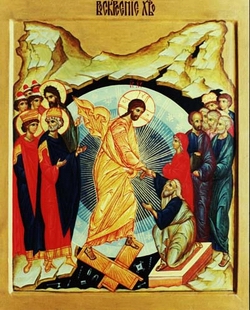
PASCHAL EPISTLE
11:00 PM
To the clergy and the entire beloved flock of the Canadian Diocese of the Russian Orthodox Church Abroad
CHRIST IS RISEN!
Honorable fathers, beloved in the Lord brothers and sisters!
“Now all things are filled with light, heaven and earth, and the lower regions! Let all creation therefore celebrate the arising of Christ, for in Him it is made firm,” – exclaims the Holy Church on this Great day of the Glory of the Lord.
The Resurrection of Christ opened before us the gates of eternity. It was said in the pious poetic tradition of our fathers, who dwelt in the land of Holy Russia, that from the first day of the Bright Resurrection of Christ, the gates of heaven open and stay open until the last day of the Bright Week. More than that, even the torments of hell cease and quiet down, and sinners are given rest even until Pentecost.
This shows with what grace-filled spiritual uplifting the Russian people greeted the Feast of feasts – the Pascha of Christ. Do we follow their example? Are we enveloped with the joyous all-forgiving state of mind, as it is spoken of in the homily of St. John Chrysostom, which is read at the Paschal matins? Yet, this Paschal feeling is the gift of a special mystical grace, which the faithful receive from the Lord, as a certain foretaste of the heavenly joy, the joy of the Unwaning Light. Compared to this joy, how insignificant and pitiful must be our quarrels and offenses, our divisions into conflicting groups, our sinful remembrance of wrongs, which, according to the words of the Most Blessed Metropolitan Anthony, founder of our Russian Church Abroad, “Entrance into the Heavenly Kingdom is closed to us.”
In the last year, we became witnesses of the most cruel raging of the elements: destructive floods, dreadful frequent earthquakes, which, in a blinking of an eye, destroy, it appears, the most perfect human achievements. This reminds us of the fact that all of us, as a Russian saying says, walk under God, and none knows when the Lord will call us, and all of this is the fulfillment of the gospel words of the Savior about the signs of the times.
Therefore, Pascha – this type of the future, eternal Pascha – reminds us of the necessity of always being attentive to our salvation, so that we, living here on earth, would never forget all the needy with our mercy, whoever these needy may be, in the times when they are met with sorrow. Then, we also will be vouchsafed an opportunity to fulfill the commandments of Christ by good works and pious life, and to be partakers of the eternal Paschal joy in the Risen Lord.
Let us remember, beloved brothers and sisters, that “Today – on this very day – a sacred Pascha has appeared unto us, a Pascha new and holy, a Pascha mystical, a Pascha all-honorable” and let us repeat in our hearts the tender and triumphant words of the Apostle Paul: “My brethren, rejoice in the Lord always, and again I say rejoice… the Lord is near… and the peace of God, which is beyond all understanding, will keep your hearts and your thoughts in Christ Jesus” (Phil. 4:4-7).
Truly Christ Is Risen!
Gabriel
Bishop of Montreal & CanadaPascha of Christ, 2011
-
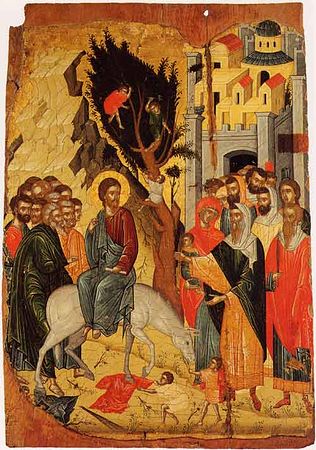
April 4/17 – Entry of the Lord into Jerusalem (Palm Sunday)
11:37 PM
Rejoice greatly, O daughter of Sion; proclaim it aloud, O daughter of Jerusalem; behold, the King is coming to thee, just, and a Savior; he is meek and riding on an ass, and a young foal (Zach. 9:9).
Entry of The Lord Jesus Christ in JerusalemThe prophet of God pronounced this prophecy over four hundred years before the event that we commemorate and celebrate today. Having completed His preaching on the earth, our Lord Jesus Christ made His triumphant entry into the royal city of Jerusalem, into the city where the true God was worshipped, a city in most ways Godly. The Lord made this entry as the King and victor, in order to finish His service by a decisive exploit: destroying death by death; removing the curse from the human race by taking this curse upon Himself. He made His entry into the royal city on the colt of an ass, whereon yet never man sat (Lk. 19:30), in order to restore to mankind the royal dignity which our forefather had wasted; to restore this dignity by ascending the cross. The unbroken colt was tamed beneath the wondrous Rider. The Apostles placed their garments upon the colt; great multitudes of people ran ahead to meet the Lord and walk alongside Him, shouting in their ecstasy, Hosanna to the son of David: Blessed is he [the king (Lk. 19:38)] that cometh in the name of the Lord; Hosanna in the highest (Mt. 21:9). The Lord is proclaimed King in the name of the Lord at His own beckoning—not accidentally, and not by conscious human will. In the course of four days, those same people who that day proclaimed Him King will cry, Away with him, away with him, crucify him… We have no king but Caesar (Jn. 19:15).
What is the significance of the Lord’s riding into Jerusalem on an unbroken colt? According to the explanation of the holy fathers, this has a deep, prophetic meaning. The all-seeing Lord already saw the Jews’ approaching final apostasy from God. He announced this apostasy even back when the Law was given to the Israelites on Mt. Sinai, through the lips of the inspired Law-giver. They have sinned, said Moses of the Jews’ future sin against the God-man, as if he were speaking of something already done. They have sinned, not pleasing him; spotted children, a froward and perverse generation. Do ye thus recompense the Lord? (Deut. 32:5–6). It is a nation that has lost counsel, neither is there understanding in them. They had not sense to understand: let them reserve these things against the time to come (Deut. 32:28–29). For their vine is of the vine of Sodom, and their vine-branch of Gomorrha (Deut. 32:32). While to the contrary: Rejoice, ye heavens, with him—the Son of God—and let all the angels of God worship him; rejoice ye Gentiles, with his people, and let all the sons of God strengthen themselves in him (Deut 32:43). The entry into Jerusalem upon an unbroken colt is a repetition of Moses’ prophecy—not in words, but in symbol. Moses foretold that the Gentiles would rejoice in the Lord, but the Jews would be rejected. Here, the unbroken colt, whereon yet never man sat (Lk. 19:30), is an image of the Gentiles. The Apostles’ garments are Christ’s teachings by which they would instruct the Gentiles, and the Lord seated Himself spiritually upon the Gentiles, making them God. He led them into Jerusalem, to the bosom of the Church, to the eternal city of God not made by the hands of men, to the city of salvation and blessedness. The rejected Jews were also present there. With their lips they cried, ”the King of Israel,” but in their soul, their Sanhedrin, they had already resolved to kill the Savior.
Here is another meaning of the colt of an ass. It is an image of every person who is led by irrational desires, deprived of spiritual freedom, attached to the passions and habits of fleshly life. Christ’s teaching looses the ass from its attachment; that is, from fulfilling its sinful and fleshly will. Then the Apostles lead the ass to Christ, place their garments upon it; the Lord seats Himself upon it and makes His entry upon it into Jerusalem. This means that the person who has left his sinful life is led to the Gospels, and is clothed as if in apostolic vestments, in the most detailed and refined knowledge of Christ and His commandments. Then the Lord seats Himself upon him by spiritually appearing to him and spiritually abiding in him, as it was His good will to promise: He that hath my commandments, and keepeth them, he it is that loveth me: and he that loveth me shall be loved of my Father, and I will love him, and will manifest myself to him (Jn. 14:21). And my Father will love him, and we will come unto him, and make our abode with him (Jn. 14:23). The Lord’s coming is accompanied by peace surpassing words and comprehension; peace that is full of grace, and worthy of the one Who grants it—the Lord. This peace is not to be compared with the natural rest of fallen man, who may feel rest and pleasure from fleshly delights, and who may consider his own insensibility, his own eternal death, to be rest. The Lord is seated upon the natural qualities of the person who has submitted to Him and has assimilated His all-holy teachings; and He leads that person into the spiritual city of God, the city of peace—into the Jerusalem created by God, and not by man.
The soul that upholds the Lord is greeted by the Holy Spirit, Who offers that soul spiritual joy which is incorruptible and eternal. Rejoice greatly, O daughter of Sion, the daughter of the Holy Church—because you belong to no one but God. Proclaim it aloud, O daughter of Jerusalem; behold, the King is coming to thee, just, and a Savior; he is meek and riding on an ass, and a young foal (Zach. 9:9). You have felt the grace-filled peace of Christ, and become a daughter of this peace; you have been renewed with spiritual youth and have come to know Christ’s Kingdom by experience. The passions are tamed in you by the grace-filled power of Rider Who steers you; your natural qualities cannot break their natural laws, they cannot go beyond their boundaries and be transformed into uncontrolled passions! Taking all your thoughts, feelings and actions from the Lord, you can and must proclaim the Name of the Lord to your brethren, and hymn Him in the midst of the Church (Ps. 21:22). As one born of the Holy Spirit and a daughter of the Spirit, you are able to behold the spiritual procession of your King, you are able to behold the righteousness of your King. He is meek and lowly in heart (Mt. 11:29), and He will guide the meek in judgment, He will teach the meek His ways (Ps. 24:9). Our God is a Spirit which is incomparable to any created spirit, as He is in all aspects infinitely different from all creatures. The holy created spirits are His thrones and chariots. He is seated and rides upon the Cherubim; He is seated and rides upon those blessed human souls who have submitted to Him and brought all their natural qualities to Him as a whole burnt offering. The King rides upon such souls, and enters the holy city of God, bringing holy souls into it also. Hosanna in the highest! Blessed is the King of Israel that cometh. Amen.
St. Ignatius (Brianchaninov)
Translated by Nun Cornelia (Rees)www.pravoslavie.ru/en
-
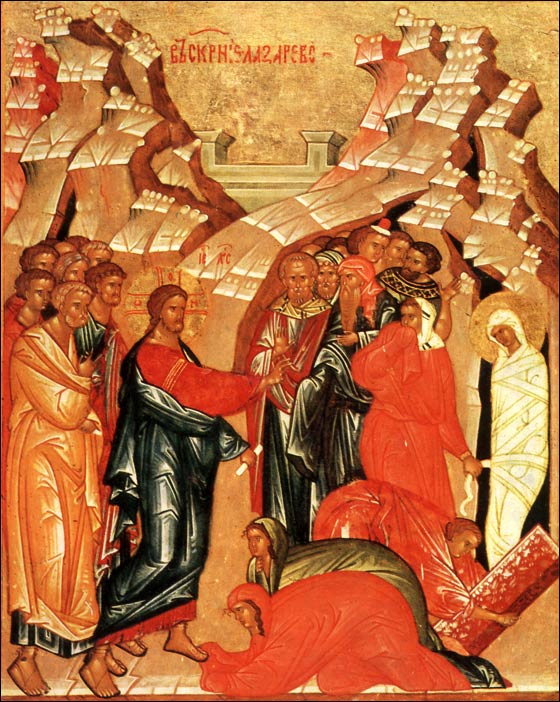
April 3/16 – Lazarus’ Saturday
11:28 PM
The story of the raising of Lazarus from the dead by Jesus Christ is found in the Gospel of John 11:1-45. Lazarus becomes ill, and his sisters, Mary and Martha send a message to Jesus stating, “Lord, he whom you love is ill.” In response to the message, Jesus says, “This illness does not lead to death; rather it is for God’s glory, so that the Son of God may be glorified through it” (vv. 1-4).
Jesus did not immediately go to Bethany, the town where Lazarus lived with his sisters. Instead He remained in the place where He was staying for two more days. After this time, He told his disciples that they were returning to Judea. The disciples immediately expressed their concern, stating that the Jews there had recently tried to stone Him (John 10:31). Jesus replied to His disciples, “Are there not twelve hours of daylight? Those who walk during the day do not stumble, because they see the light of this world. But those who walk at night stumble, because the light is not in them” (vv. 5-10).
After He said this, Jesus told his disciples that Lazarus had fallen asleep and that He was going there to wake him. The disciples wondered why He would go to wake Lazarus, since it was good for him to sleep if he was ill. Jesus, however, was referring to the death of Lazarus, and thus told the disciples directly that Lazarus was dead (vv. 11-14).
When Jesus arrived at Bethany, Lazarus had already been in the tomb four days. Since Bethany was near Jerusalem, many of the Jews had come to console Mary and Martha. When Martha heard that Jesus was approaching she went to meet Him and said to Him, “Lord, if you had been here, my brother would not have died. But even now I know that God will give you whatever you ask of Him.” Jesus told her that her brother will rise again. Martha said that she knew he would rise again in the resurrection on the last day. Jesus replied, “I am the resurrection and the life. Those who believe in me, even though they die, will live, and everyone who lives and believes in me will never die.” Jesus asked Martha if she believed this. She said to Him, “Yes, Lord, I believe that you are the Messiah, the Son of God, the one coming into the world” (vv. 17-27).
Martha returned to tell Mary that Jesus had come and was asking for her. Mary went to meet Him, and she was followed by those who were consoling her. The mourners followed her thinking that she was going to the tomb to weep there. When she came to Jesus, she fell at His feet and said, “Lord, if you had been here, my brother would not have died.” Jesus saw her weeping and those who were with her, and He was deeply moved. He asked to be taken to the tomb of Lazarus. As Jesus wept for Lazarus the Jews said, “See how He loved him.” Others wondered that if Jesus could open the eyes of the blind, He certainly could have kept Lazarus from dying (vv. 28-37).
Jesus came to the tomb and asked that the stone that covered the door be taken away. Martha remarked that Lazarus had now been in the tomb for four days and that there would be a stench. Jesus replied, “Did I not tell you that if you believed, you would see the glory of God?” The stone was taken away, and Jesus looked toward heaven and said, “Father, I thank you for having heard me, but I have said this for the sake of the crowd standing here, so that they may believe that you sent me.” When He had said this, He called out with a loud voice, “Lazarus, come out!” Lazarus walked out of the tomb, bound with the strips of burial cloth, and Jesus said, “Unbind him, and let him go” (vv. 38-44).
As a result of this miracle, many of the Jews that were present believed in Jesus. Others went and told the Pharisees what Jesus had done. In response the Pharisees and chief priests met and considered how they might arrest Him and put Him to death (v. 45ff).
This miracle is performed by Christ as a reassurance to His disciples before the coming Passion: they are to understand that, though He suffers and dies, yet He is Lord and Victor over death. The resurrection of Lazarus is a prophecy in the form of an action. It foreshadows Christ’s own Resurrection eight days later, and at the same time it anticipates the resurrection of all the righteous on the Last Day: Lazarus is “the saving first-fruits of the regeneration of the world.”
As the liturgical texts emphasize, the miracle at Bethany reveals the two natures of Christ the God-man. Christ asks where Lazarus is laid and weeps for him, and so He shows the fullness of His manhood, involving as it does human ignorance and genuine grief for a beloved friend. Then, disclosing the fullness of His divine power, Christ raises Lazarus from the dead, even though his corpse has already begun to decompose and stink. This double fullness of the Lord’s divinity and His humanity is to be kept in view throughout Holy Week, and above all on Good Friday. On the Cross we see a genuine human agony, both physical and mental, but we see more than this: we see not only suffering man but suffering God.
www.goarch.org