News
-
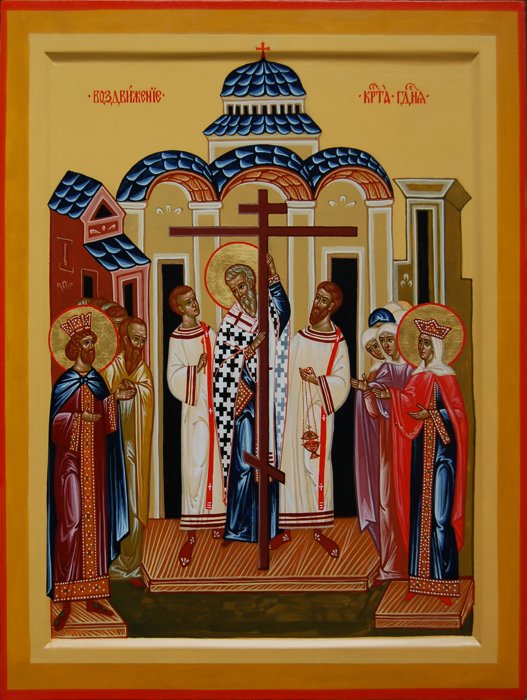
September 14/27 – The Elevation of the Precious and Life-giving Cross
12:00 PM
“From the first days of the preaching of the apostles, already persecution of the Church of Christ began… The very places of the crucifixion, burial and resurrection of the Lord were covered with a multitude of stones and garbage in order only to take away from Christians the access to them and the ability to recognize them” (G. Lavrentiev. Twelve great feasts of the Orthodox Church, St. Petersburg, 1862). Yet, these holy places, keeping in memory the voluntary passion of the Saviour of the world, continued to draw the faithful.
In the beginning of the second century A.D. the roman emperor Hadrian completely rebuilt the Holy City and took away its ancient name; from then on Jerusalem was called Aelia Capitolina. Among other things, a decision was made to fill the hollow between Golgotha and the garden of Joseph of Arimathea. Later on, the entire plot of land adjacent to the place of the sufferings of the Lord on the cross was levelled; in order to do that, the top of Golgotha had to be cut and the cave of the Holy Tomb had to be filled. On this levelled place, the emperor erected a temple of Venus and Cupid.
As the result, exactly the opposite of what the enemies of Christ wanted took place: by the providence of God, the building of Hadrian as if marked the holy place, thus, excluding the possibility of loss of the knowledge that was preserved by the early Church.
Therefore, from 135 A.D, (when emperor Hadrian allowed Christians to return to Jerusalem) and until 326 A.D. (when St. Helena, the elderly mother of Equal-to-the-apostles Constantine, arrived in Jerusalem) the topographical history of the Gospel events, preserved in the original community of the faithful, managed – in the expression of the Greek Orthodox Encyclopaedia – “without dark spots”. St. Helena was able to find the Tomb of the Lord and the Trembling Golgotha. “They removed layer after layer, – describes the dig the contemporary of the finding, “the father of Church History” Eusebius Pamphilus. – And suddenly, in the depth of the earth, beyond any expectation, there appeared an empty space, and then – the precious and all-holy sign of the saving Resurrection”. That was the cave of the tomb.
In 351 A.D., St. Cyril of Jerusalem addressed the heir of St. Constantine – emperor Constantius – with a letter, where it is said exactly that “in the days of your father Constantine, may his memory be blessed”, near the Holy Tomb, the Life-giving Cross of the Lord was found. According to ancient tradition, the place, where the Holy Cross was buried, was pointed to – under duress – by someone named Judah, called “prophet’s son”.
But the unconquerable power of the Lord’s Cross reached him as well: seeing with his eyes the wonders from the unearthed instrument of a shameful death, Judah, along with others, his fellow countrymen, believed in the Crucified One “and was baptized, and in the holy baptism he was called Cyriacus; later on he became patriarch of Jerusalem. In the time of the emperor Julian the Apostate, he was tortured for Christ and having received a martyr’s wreath, was numbered among the saints”. (Lives of Saints, Word about the Elevation of the Cross of the Lord).
St. John Chrysostom says that it was possible to distinguish the Cross of Christ from those of the robbers, that were similar, by the table with an inscription made by the order of Pontius Pilate. In the description of the historian Sozomenus, that was included in the Lives of Saints, it is said that the tablet was found lying separately. It was possible to identify the Cross of Jesus only thanks to the miracle of the healing of a gravely ill woman and of the resurrection. “When the Patriarch with the Queen and the people, who were carrying the crosses out of the house of her that was healed, they met a large funeral procession of a certain Jew. Filled with faith, the Patriarch stopped the procession and having come up to the bier, placed all three crosses upon the dead man…; only the Cross of the Vanquisher of death and the Source of life broke the bonds of death and the dead man returned to life!”.
The discovered Tree, as is said in a letter of St. Cyril of Jerusalem, spread throughout the entire universe, for its parts were given to churches. People say that, to this day, requests go to the Jerusalem Patriarchate, to give to this or that local church a piece of the Holy Cross, but it is, of course, impossible to fulfill them: exactly this way, little by little, the portion of the Cross sent by St. Helena to Constantinople, vanished, ceased to be.
In 1799, during the reign of the Emperor Paul Petrovitch, the Ist, once he received the title of the great master of the Malta order, a portion of the Lifebearing Tree, along with other holy objects – the right hand of St. John the Baptist and the Icon of the Mother of God of Philermos – were brought from Malta to Russia, where they were kept in the Gatchina palace, then in the Winter palace, and when a cathedral in honour of Ss. Peter and Paul was erected in Gatchina, they once again returned to that town. The feast of the Philermos icon, in memory of the bringing of the wonderworking image to Russia, was set in 1800 on the 12th of October, Old Style.
After the October revolution of 1917 the holy objects ended up in the vestry of the Archangels’ cathedral of Moscow Kremlin, then in Estonia, Denmark, Germany, and finally, in Serbia. During World War II the relics were preserved in the Montenegro monastery. Almost ten years they were hidden in the monastery of St. Basil of Ostrog, but when in the beginning of the nineteen fifties, communists seized the power in Yugoslavia, they were taken and placed in a museum. Only in the summer of 1993, on the day of the feast of the nativity of St. John the Forerunner, the right hand of St. John the Baptist and a piece of the Life-giving Cross of the Lord were returned to the Church and given to the Cetinjski monastery of the Nativity of the Most Holy Theotokos.
When the Holy Objects left Russia, a copy of the icon of the Mother of God and a painting of the right hand of St. John the Forerunner were made in Gatchina. In the nineteen nineties, Gatchina Ss. Peter and Paul cathedral received as a gift a piece of the Tree of the Life-giving Cross of the Lord.
-
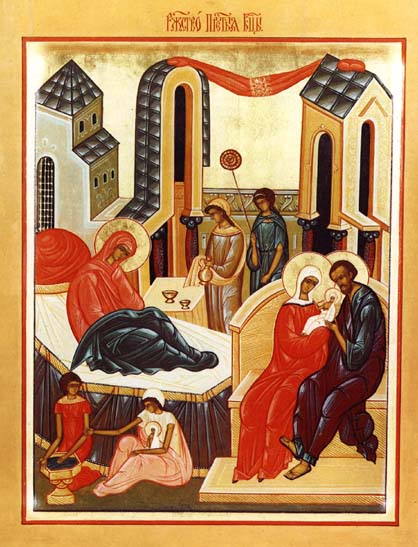
Nativity of our Most Holy Lady the Theotokos and Ever-Virgin Mary
12:00 PM
The Eastern Orthodox Church starts the count of the yearly circle of the feasts with the Nativity of the Mother of God and closes it with Her Dormition.
“She is the flower that budded forth from the barren and old womb of the dry tree, – is said of the Mother of God in the Lives of the Saints, – the flower that withers not, ever blooming with virginity, a fragrant flower, giving birth to the sweet fragrance of the One King, the flower bringing forth the fruit – Christ the Lord God, the only sweet smelling apple” (September, day 8).
The details of the Nativity of the Ever-Virgin, adopted by iconography and the order of the festive service, are contained in the Sacred Scripture, the essence of which is transmitted by the so called “Protevangelium” of James the brother of God. The content of “Protevangelium” is found in the Lives of the Saints of St. Demetrius of Rostov.
“In the records of the twelve tribes of Israel was Joachim, a man rich exceedingly,” – says the “Protevangelium” of James. When the feast arrived once again, and he brought before the Lord generous gifts and offerings, one from the tribe of Ruben stood before him and reminded that Joachim, as a man with no offspring, should not come with first offerings because “he didn’t produce a first born in Israel”. Joachim was exceedingly vexed; he didn’t return to his wife Anna, but went into the desert and there set up his tent. Then, he fasted for forty days and forty nights, saying to himself: I shall neither turn to food nor drink, until the Lord my God will look upon me. Prayer shall be my food”.
Meanwhile, Anna’s maid tried to comfort her bitterly weeping mistress, but having heard: “Leave me!”, herself got offended: “Who am I that I should hear such a thing from you?! The Lord shut your womb, willing that your offspring be not accepted in Israel”. As we can see, the Lord’s choice demanded that the righteous couple humble themselves in the face of scorn, – for, in the words of the One, Who will soon come and be their Daughter, the Creator “sent the rich empty away”, however He heard the tearful and broken prayer of Joachim and Anna.
As the most ancient – partly written – sources, that mainly came to us from the apostolic century, state, the parents of the Most Holy Virgin owned a home in Jerusalem not far from the Sheep’s Pool, where, later, the Lord healed the paralytic, who was bound to his bed for thirty eight years.
A great basilica was erected at the place of this home, the memory of its location was passed down by the Palestinian Christians from generation to generation, during the Byzantine times; according to many archaeologists, this church at once covered both the home of the righteous God-parents and the Sheep’s Pool.
After the Third Ecumenical Council in Ephesus, when the tradition regarding the Nativity of the Ever-Virgin enter the service books of the church, the home of Joachim and Anna became known to the majority of the communities of the faithful. The Council took place in the year 431 AD, and by the end of the fifth century, the Nativity of Mary began to be celebrated in Jerusalem: specifically in the church at the place of the home of the holy God-parents, St. John of Damascus gave his Divinely inspired Homily: “The Day of the Nativity of the Theotokos is the feast of joy for the entire world because the entire race of men was renewed through the Theotokos… She is entirely the abode of the Spirit, entirely the city of God, entirely good, entirely God’s neighbour”.
-
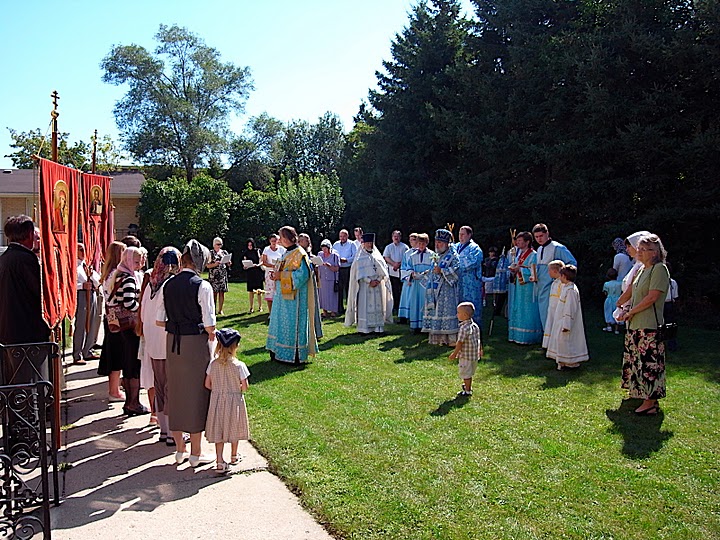
60th Anniversary of the Saviour Not Made with Hands Parish in London (Ontario)
10:23 AM
This year, the parish feast of the churh of the Icon of the Savior Not Made with Hands, celebrated as the third feast of the Savior, fell on the 60th anniversary of the parish.
On Sunday, August 16/29, with a large group of the faithful, His Grace, Gabriel, Bishop of Montreal and Canada, served Divine Liturgy assisted by the rector of the parish, Protopriest Vladimir Morin, Protodeacon Vasili Milonow (Protection Memorial Church, Ottawa, Ontario), and Deacon Alexander Morin (Holy Trinity Cathedral, Toronto, Ontario).
There was a cross procession with a prayer service. His Grace, Bishop Gabriel, blessed a memorial plaque, especially prepared for this feast day in honor of Ivan Vasilievitch Gavrilik, who in 1958 donated to the parish the plot of land, upon which the current church of the Icon of the Savior Not Made with Hands is erected. The plaque is for the eternal memory of the gracious benefactor’s son – Alexander, who died in a car accident at the age of 22.
After the cross procession and moleben everyone was invited to a meal.
Предлагаем читателям праздничный фоторепортаж, подготовленный Андреем Звонковым, прихожанином храма Нерукотворенного Спаса.
-
Celebration in honor of Archbishop Joasaph
10:02 AM
Thursday 14 October
m. Hilarion arrives late in the evening
Friday 15 October Rawdon
Church of Holy Virgin of Kazan Rawdon
- Greeting of m. Hilarion (10am)
- Panehida at Russian Cemetery (11 am)
- Meeting mayor of Rawdon
- Visit environs
- Trapeza
Friday 15 October Montreal
Visit Sts Peter and Paul Cathedral (2:30-3:30 pm)
Friday 15 October Montreal
Montreal City Hall (3:30-4:00pm)
Friday 15 October Montreal
- Matins (6pm)
Saturday 16 October Lachine
Church of St. John
- Greeting m. Hilarion (9am)
- Liturgy
- Trapeza
Saturday 16 October Cathedral
- Cossack Stanitsa Reception (2-3pm)
Saturday 16 October Cathedral
- Vespers (6pm)
Sunday 17 October Cathedral
Liturgy
- Greeting m. Hilarion (9am)
- Panehida
Trapeza Activities (12:30-15:30)
- The Enlightener Photos & Life
- Concert Quartet
- School
-
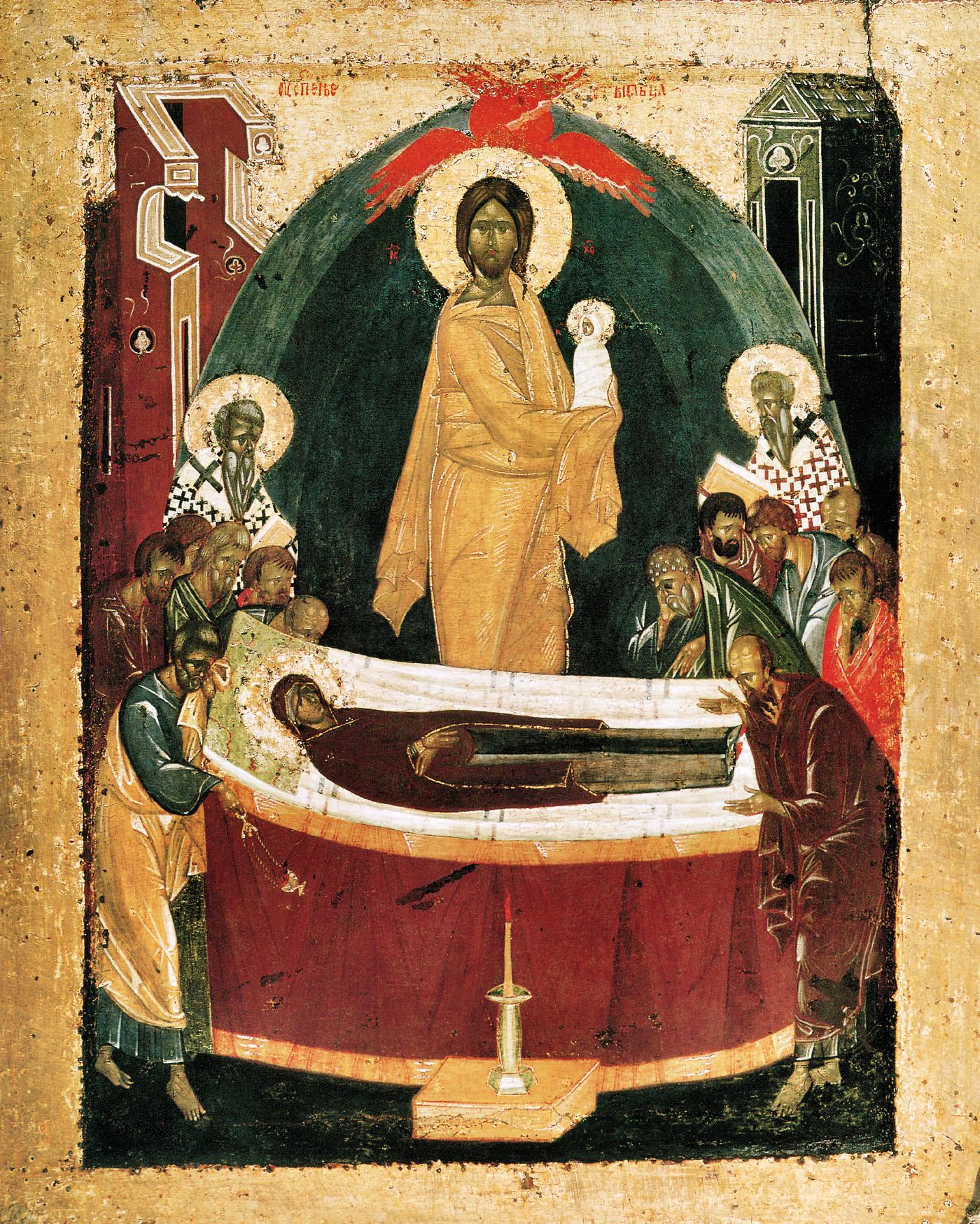
August 15/28 – Dormition of our Most Holy Glorious Mistress, the Theotokos and Ever-Virgin Mary
06:52 AM
After the ascension of the Lord, the Mother of God remained in the care of St. John the Theologian, and in his absence, she lived in the house of his parents near the mount of Olives. She planted and confirmed the Christian Church by Her presence, Her word, and Her prayers. During the persecution, initiated by Herod against the young Church of Christ (Acts 12:1-3), Most Holy Virgin Mary together with the apostle John the Theologian, in the year 43, moved to Ephesus, where it was his lot to preach the Gospel. She was also on Cyprus, visiting St. Lazarus the Four-days-dead, who was the bishop there, and on the Holy Mount Athos, of which, as says St. Stephen of the Holy Mountain, the Mother of God said prophetically: “This place shall be my lot, given to me by my Son and my God. I shall be a protectress of this place and an intercessor for it before God.”
According to the tradition preserved by the church historian Nicephoros Callistos (XIV cen.), the Mother of God “was of medium hight, or as some say, somewhat taller than medium; had golden hair; quick eyes, as though of olive color; brows bowing and somewhat elongated, elongated nose; flourishing lips, filled with sweet speeches; face neither round, nor sharp, but somewhat elongated; long hands and fingers… In speaking with others, She preserved pious appearance, didn’t laugh, didn’t become indignant, and especially didn’t get angry; perfectly natural, simple, She did not think anything of Herself, and far from being pampered, was distinguished by complete humility. Regarding the garments that She wore, She was satisfied with their natural colors, a fact to this day testified to by Her sacred head covering. Shortly speaking, in all Her actions a special grace was manifest”. (Nicephoros Callistos borrowed his description from St. Epiphanes of Cyprus +May 12, 403).
The circumstances of the Dormition of the Mother of God are known in the Orthodox Church from the apostolic times. In the first century hieromartyr Dionysius the Areopagite wrote about Her Dormition. In the fourth century, St. Epiphanes of Cyprus points to the tradition regarding the Dormition of the Mother of God. In the fifth century, St. Juvenal, the Patriarch of Jerusalem, said to the holy right-believing Greek empress Pulcheria: “Even though there is no narrative about the circumstances of Her passing in the Holy Scriptures, still, we know about them from the most ancient and most true tradition”.
For the time of Her blessed Dormition the Most Holy Virgin Mary once again came to Jerusalem. She spent days and nights in prayer. Often, the Most Holy Theotokos came to the Holy Tomb of the Lord, offered incense there and bowed Her knees. Many times, the enemies of the Savior attempted to prevent Her from visiting the holy place and asked high priests for guards to watch at the Lord’s Tomb. Yet, the Holy Virgin, unseen by anyone, continued to pray before it.
According to the testimony of the byzantine Church historian George Kedrin, the falling asleep of the Theotokos was preceded by somewhat of a second Annunciation: “Once, the Most Holy Virgin, was praying on Her knees at the very place, where Her Son was praying about the Divine Cup, – then, suddenly, Archangel Gabriel stood before Her, and giving Her the sign of victory over bodily death, a branch of date palm from paradise, – announced Her imminent passing, that would come about in three days”. George Kedrin writes that this branch, after Dormition, was carried before the bier of the Theotokos by St. John the Theologian.
On the third day after Dormition of the Theotokos the unconsolable apostle Thomas came to Gethsemane and weeping bowed before the cave of the tomb. Taking pity for his sorrow, the other disciples agreed to move the stone, covering the entry into the tomb, away, however, the Most Pure Body was no longer in it because the Most Holy Theotokos “fell asleep in death for a short time as though for a short sleep, and soon as though from sleep, arose and shook off the death in the tomb as sleep from Her eys, and saw in the light of the Lord’s Countenance eternal life and glory” (From the canon for the feast of Dormition).
Testimonies remain that at the end of the seventh century there existed over the underground church of the Dormition of the Most Holy Theotokos a church, from the tall bell tower of which one could see the dome of the church of the Resurrection of the Lord. Now, there are no visible signs of the existence of this church. In the ninth century, next to the underground Gethsemane church a monastery was built, that was inhabited by 30 monks.
In 1009 the church suffered great damage from the persecutor of the holy places, calif Hakim. Significant changes, traces of which remain to this day, were made by the crusaders. In the eleventh and twelfth centuries, a portion of cut stone, upon which the Lord prayed on the night of His betrayal, disappeared from Jerusalem. Until the sixth century, this portion of the stone was in the Gethsemane basilica.
Yet, despite destruction and changes, the general initial cross-shaped plan of the church is preserved until today.
Wondrous was the life of the Most Pure Virgin, wondrous also was Her Dormition, as the Holy Church chants: “The God of the universe manifests in Thee, O Queen, wonders above the laws of nature. At the time of Nativity, He preserved Thy virginity, and in the tomb He preserved Thy body from corruption” (Canon 1, Ode 6, Troparion 1).
-
2010 Fall Pastoral Clergy Gathering to be Held in Vancouver, BC
09:23 PM
The annual fall Pastoral gathering of the diocesan clergy this year will take place at the Holy Trinity church in Vancouver, British Columbia. The event will be held from October 5/18th until October 7/20th, 2010. The program of the meeting will be published in the nearest future.
-
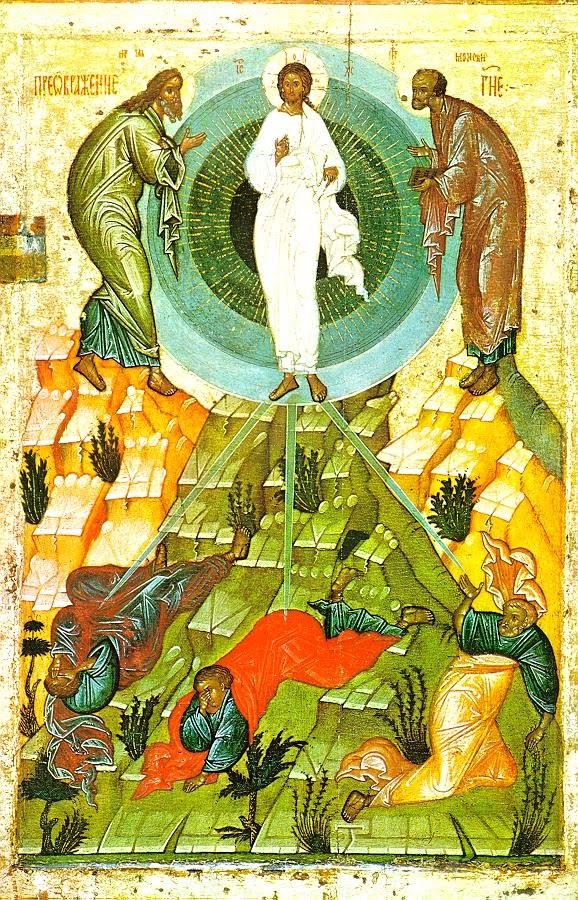
August 6/19 – Holy Transfiguration of Our Lord God and Savior Jesus Christ
12:00 PM
In the Transfiguration of the Lord the mystical nature of the One, Who in those days was called a Nazarene or a Prophet, instantly became manifest to the three disciples whom He chose Himself, or, in the church language, this Nature manifested Itself through the human flesh of Jesus. Apostles Peter, James, and John saw the Son, Whose countenance shone “like the son”, “His garments became shining, very white, like the snow, white like no person on earth could make them.” At the same time the Apostles felt upon themselves tangible “grace of the Holy Spirit, coming like a noetic light, bringing joy” (from the words of St. Symeon the New Theologian). When, for a time, penetrated by this light Peter cried out: “Lord! It is good for us to be here”, the voice of the Heavenly Father, that said: “This is My beloved Son, in Whom I am well pleased; listen unto Him” (Matthew 17:4) became intelligible to him, to James and to John.
The author of the third Gospel, holy apostle Luke, in his description of the Transfiguration, lists three most important details: the appearance of the Lord’s “countenance” changed during prayer; Prophets Moses and Elias talked with Jesus “about His passing, which He had to accomplish in Jerusalem” (Luke 9:31); the disciples themselves were “heavy with sleep” and that , in a way, foreshadowed the overwhelming black sleepiness that was soon to come upon the apostles in the garden of Gethsemane.
“The Prophets and Apostles were filled with joy, – says St. Ephraim the Syrian. – The Prophets rejoiced, because they saw here His humanity that they didn’t see before, the Apostles rejoiced, because they saw here the glory of His Divinity that they didn’t know before.”
The church tradition, going back at least to the third century of christian era, states that Transfiguration took place upon mount Tabor, in the southern part of Galilee.
“Mount Tabor, heaven on earth, exultation of the soul and the nourishment of the eyes of the orthodox: because some divine grace is present, overshadowing the mountain, and that inspires spiritual joy”, – wrote a greek from Crete, the author of the pilgrim’s notes John Phocas, whose visit to the Holy Places of Palestine took place in the year 1187. Yet, it is difficult to say what exactly did he see upon mount Tabor: some sources say that already in 1181 the armies of calif Saladdin destroyed the local monasteries and churches, killing the monks, and built a fortress on the ruins in order to ward off the attacks of the crusaders.
“In the year 1217, crowds of the crusaders, made up of pilgrims, gathered under the direction of the kings: Andrew of Hungary, Hugo of Cypress, and John of Jerusalem, on the day of St. Andrew camped at the foot of Mount Tabor against the fortress situated at the top” – says professor of divinity Benjamin Ioannidis, author of a recent and famous description of the Holy Land. – The Saracen garrison, as soon as the approaching army of the crusaders was spotted, set out against them at the gates of the fortress… Many of the cavaliers of the Orders of St. John and of the Temple died without any success…”.
A century earlier, the glorified “Igumen of the Russian Land” Daniel mentions the churches on Tabor in his “Pilgrimage”: “There is a high place at the very top of that mountain, as if a rock, small and sharp at the top, that is the place where Christ our God was transfigured; there is a good church in honor of Transfiguration there, and another one in honor of the holy prophets Moses and Elias.”.
Later on, all of this disappeared at the efforts of the destroyers, and only in the 19th century, greek Orthodox church was built on Tabor, where one can see the remains of the buildings from the times of St. Helena, mother of holy equal-to-the-apostles Emperor Constantine. The guide for the Russian pilgrims, published in 1894, says: “Pilgrims spend almost an hour in order to climb the mountain of Transfiguration. At the wall of the greek monastery the caravan is met by bell ringing and the pilgrims go straight into the church… Having worshipped at the holy place, they settle within the walls of the monastery in any way they can. The entire building of the monastery, even the church, is wide open to receive the travelers from afar. In the evening, our Russian hieromonks, along with all the brethren of Tabor, clergy from the pilgrims and in the presence of the Metropolitan (of Nazareth) serve the all-night vigil, and later on, closer to sunrise, Liturgy in church slavonic.”
The shining of the light of Tabor – uncreated light – right next to the sleeping sinful people contains within itself a promise: “It is impossible for Him not to enlighten those, who in a worthy manner participate in the Divine radiance of His Body within us”, – writes St. Gregory Palamas. It was specifically in this manner that St. Seraphim of Sarov vouchsafed his friend and disciple N.A. Motovilov to become a fellow seer and fellow participant in being in the Light of the Transfiguration. “Imagine, in the middle of the sun, in the very brilliant radiance of its noon rays, the face of the man, who is speaking with you. You see the movement of his lips, the changing expression of his eyes, hear his voice, but see neither yourself, nor his figure, save for solely the blinding light, spreading far, and illuminating with its bright shining the snow, which covers the meadow, along with the snow flakes, covering from above both me and the Great Elder”, – related Motovilov about what took place.
In continuation of the Old Testament tradition, the fruit of the earth – ears of grain and grapes, “for from them comes the wine for the bloodless sacrifice”, are blessed on the feast of Transfiguration. Usually, in Russia apples are blessed. The Church entreats the Lord, that He grant to those eating the fruits sanctification of the soul together with the sanctification of the body, that He would keep their life in peace and joy, and that He multiply the fruits. The Church of Christ blesses and sanctifies the offered fruits with the holy Name of God, glorified in the Trinity.
-

About the One Thing Needful
09:45 PM
There appeared on the internet a reply to the Synod of Bishops’ open letter addressed to the suspended clergy of the South American Diocese of the Church Abroad (http://russianorthodoxchurch.ws/synod/2010/sadioceseletter.html). The author of this reply is the defrocked bishop Agathangel Pashkovskiy, who calls himself “metropolitan” (http://sinod.ruschurchabroad.org/100804.htm).
Neither the letter of the Synod, nor the preceding appeal to the Synod from the South American clergy were addressed to the former bishop Agathangel.
However, we decided to reply to his commentaries since our letters are addressed not only to Latin America, but are intended for all, who came to be outside of the Church’s fold.
First of all, we assure former bishop Agathangel that, despite his feelings, the letter of the Synod of Bishops, to which he responded, was not written in Russia. Its collective authors were exclusively native members of the ROCOR, who were never in another jurisdiction, not even for a day. These individuals can in no way be numbered among the “contemporary Russians” because most of them were born outside the borders of our Historic Fatherland. It also is not clear where in the letter of the Synod of Bishop did the former bishop Agathangel find the call to “return to Russian Federation”, as well as the statements “as though in Russia all is well”.
Persistent accusations in “slanting”, “falsehood” and other rest wholly on the conscience of the former bishop Agathangel. His ambition is to claim the South American diocese of the Russian Church Abroad. Yet, upon what grounds? In reality, as any interested reader may easily find out, the case is as follows: according to Part IV, paragraph 37, point “n” of the current Regulations of ROCOR, “in case of a vacant episcopal see, to take upon himself temporary control of it or to assign a bishop before the appointment of a Ruling Bishop”. That is exactly what happened after the repose of His Grace, Bishop Alexander of South America. And it was exactly the same situation that came to be after the self-initiated creation and heading of the so-called “PSEA” by the former bishop Agathangel, which meant nothing other than his refusal to obey the Synod of Bishops that issued the decree about the appointment of former bishop Agathangel to the South American cathedra. Consequently, former bishop Agathangel could then in no way claim the administration of the South American Diocese of ROCOR and that was clearly understood by the clergy of that diocese. That is the reason why some of them have petitioned Vladyka Metropolitan Laurus, as their ruling hierarch, with the request for a “canonical release”, that being the subject of discussion in their letter. We are left only to quote the words of the former bishop Agathangel, applying what he wrote to his own case: “That is known by every native member of ROCOR, the author also knows it, but he writes a lie in order to confuse the readers”.
Speaking of ecumenism, former bishop Agathangel sites history and tradition instead of the Holy Canons quite intentionally. Both (history and tradition) unlike the Holy Canons, proceed “from man and according to man” and that is why they are always confirmed by the catholic (soborny) divinely inspired mind of the Church. For example, until a particular time the Church accepted considerably more New Testament scriptures than it does now. However, can we say that our Four Gospels are the breaking of the “historic traditions”, “traditions of the elders”? The well-known statement of our Council of Bishops of the Church Abroad of the year 1983, when the teaching of ecumenism was anathematised is only the opinion, the position pronounced by the part of the Local Russian Church. By the way, that was said by the ever-memorable Metropolitan Vitaly, whose views on ecumenism are well known to all. At the same time in the Local Russian Church, both in the Fatherland and abroad, joint services together with the heterodox were never permitted and the idea of the “plurality of the truth” was never preached. The external position of the Church Abroad remains immovable: thus, in the year 2008, His Eminence, the Very Most Reverend Metropolitan Hilarion, in his presentation in Moscow, once again called upon the Russian Orthodox Church to leave the World Council of Churches. His appeal, originating within our entire Russian Church Abroad, finds ever greater numbers of supporters among the hierarchs in the homeland.
The former bishop Agathangel calls “sergianism” a sin. Yet, he forgets, that the sin, expressed in the unworthy and in the end useless attempts of the Church authorities to find a common language with the earthly powers hostile to Christianity, is not foreign to himself. When he was a hierarch, Agathangel Pashkovskiy always exhibited an excessive inclination to participate in political campaigns. During the presidential election in 2004 in the Ukraine he held very close ties with one of the candidates, in reality taking part in the so-called “orange revolution”. The name of the former bishop Agathangel is associated with one of the most criticised city mayors and that was in no way beneficial for the Church. Now, of course, he is free to do as he minds. In any case, however, the fate of the hierarchy of the Russian Orthodox Church in the Fatherland, who, according to the words of St. John of Shanghai and San Francisco, had to keep Orthodoxy on the surface of the Russian life by suffering on the cross, is in no way diminished to such accusations.
Speaking of the “unlawful seizure of churches in Suzdal”, the former bishop Agathangel for some reason fails to mention from whom these churches were seized. We are speaking of the self-styled schismatic group “ROAC” of the twice defrocked Valentine Rousantsev. The transfer of these Suzdal churches to the Orthodox Church is at least as lawful as the transfer of the seized Church properties in other Russian cities, where churches were made into warehouses, clubs, museums and prisons.
The given example confirms the very fact that there are no more persecutions of the Church in today’s Russia.
Carried away by political insinuations, former bishop Agathangel stubbornly refuses to talk about the main content of the letter of the Synod of Bishops: about the division of the Church.
We did not say a word about secular affairs. We only said that the clergy, who left the fold of the Church, who made up a self-styled gathering, lost the right and the ability to perform the Mysteries. Those, who dare to serve despite being suspended, in accordance with the Holy Canons, defrock themselves. It means that both they, and the ones who approach them as pastors, are deprived of the grace-filled Mysteries, which are the only way to salvation.
It is of nothing else, but only of this, the one thing needful, we whole-heartedly whish that they would think while it is not too late.
GABRIEL,
Bishop of Montreal & Canada
Permanent member of the Synod of Bishops -
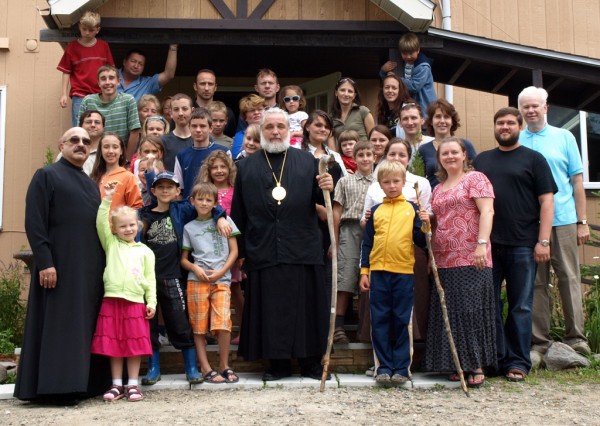
Ss. Boris & Gleb’s children’s summer camp of the A.S. Pushkin’s parish school completed this season
09:32 AM
On August 8 the annual Ss. Boris & Gleb’s children’s summer camp of the A.S. Pushkin’s parish school (www.pushkinschool.org) at St. Nicholas cathedral in Montreal, Quebec, completed this season.
This year the camp was organized in a beautiful valley north of Montreal in the area of Val-Des-Lacs.
A spacious two story cottage, with many comfortable rooms, a large dining room, well-equipped kitchen, and roomy hall, is situated there next to a mountain brook, surrounded by park forests. Next to the cottage is a fenced in swimming pool.
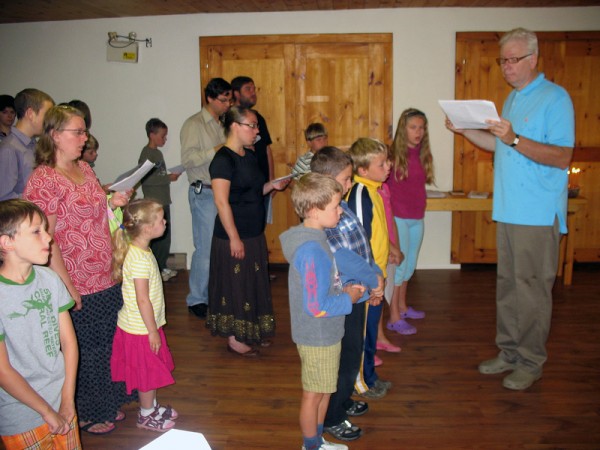
Aside from the various excursions, fishing, and of course, playing in the open air in grass covered fields, the children – during the lessons in the Law of God – prepared for the traditional divine service at the end of the summer rest.
On Sunday morning, in the hall decorated with flowers, His Grace, Gabriel, Bishop of Montreal & Canada, served the Divine Liturgy. The children’s choir, conducted by subdeacon Grigoriy Vasilievitch Borovik, sang melodiously and beautifully. Of almost forty people present – young and old – majority confessed and received Holy Communion.
After the dismissal of the Liturgy, everyone was invited to the festive meal. The main dish, for the majority, was the freshly cooked fish that the young fishermen caught at the dawn of the same day.
-
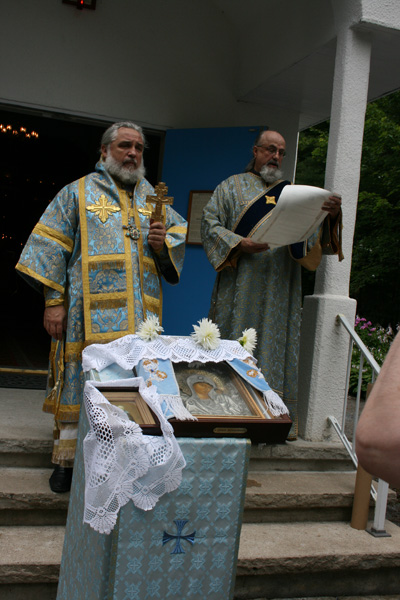
PARISH FEAST OF THE KAZAN CHURCH IN ROWDON (QUEBEC)
11:43 AM
Last Sunday the parishioners of the church dedicated to the “Kazan” icon of the Mother of God (Rowdon, Quebec) once again gathered for the festivities in honour of the approaching parish feast.
Kazan icon of the Mother of God is one of the most venerated icons of the Most Holy Theotokos in Russia. The wondrous appearance of this icon to the citizens of Kazan took place on July 8 (July 21 new style) 1579, a quarter of a century after the conquest of the Kazan khanate by Ivan the Terrible (1552) and the soon after establishment of the archbishop’s cathedra in Kazan (1555). For the Russian Orthodox Christians this icon still embodies the idea of the prayerful protection and intercession of the Most Holy Theotokos for our Fatherland.
The parish feast celebration that gathers many visitors in Rowdon, one of the most beautiful places in Quebec, is already a tradition for the Canadian diocese. It was begun in 1982, after the building of the current church in place of the original wooden one, that was damaged by fire.
His Grace, Gabriel, Bishop of Montreal and Canada, along with Protopriest George Lagodich (sacristan of the St. Nicholas’ cathedral), protodeacon Vasili Milonow (Protection memorial church, Ottawa, Ontario), and deacon Boris Sidorenko (St. Nicholas’ cathedral) served the Divine Liturgy attended by many of the faithful. The choir sounded beautifully and evenly, directed this time by subdeacon Peter Pavlovich Paganuzzi.
The Consul General of the Russian Federation in Montreal, Alexei Victorovich Isakov with wife Ludmila Vasilievna, was present at the service among the faithful.
After the dismissal there was a cross procession. Before it, standing in the doors of the church, His Grace, Bishop Gabriel read and then bestowed Diocesan gramotas to two oldest Rowdon parishioners: Olga Matfeevna Zhihareva and Ekaterina Afanasievna Potemkina, both of whom worked a lot for the good of the church.
Then, having prayed, everyone enjoyed the traditional festive meal, wonderfully prepared, as usual, by the local sisterhood headed by Tatiana Konstantinovna Nesterova-Boye.
In his address during the meal, His Grace congratulated all the parishioners with the coming parish feast, thanking them for their fervour and participation in the life of the Church. Vladyka also thanked the Rowdon sisters for the meal.
The Consul General of Russian Federation also greeted everyone. He expressed his joy that he was able for the first time see the beauty of this place and thanked the organizers for the zealous preservation of the true Russian Orthodox spirit of such feasts that unite all Russian people, who came to live in Canada in different times.
We offer you a number of photos from the event.