News
-
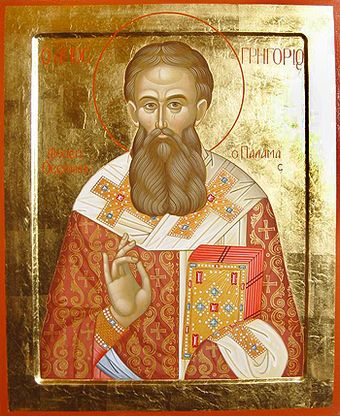
March 7/20 – 2nd Sunday of Great Lent. Commemoration of St. Gregory Palamas
05:48 PM
Saint Gregory Palamas, Archbishop of Thessalonika, was born in the year 1296 in Asia Minor. During the time of a Turkish incursion the family fled to Constantinople and found refuge at the court of Andronikos II Paleologos (1282-1328). The father of Saint Gregory became a prominent dignitiary under the emperor, but he soon died, and Andronikos himself took part in the raising and education of the orphaned boy. Endowed with fine abilities and great diligence, Gregory without difficulty mastered all the subjects which then comprised the full course of medieval higher education. The emperor hoped that the youth would devote himself to government work. But Gregory, just barely age 20, withdrew to Holy Mount Athos in the year 1316 (per other sources, 1318) and became a novice in the Batopedeia monastery under the guidance of the monastic-elder, the Monk Nikodemos of Batopedeia (Comm. 11 July), and there he accepted tonsure and began on the path of asceticism. A year later, the holy Evangelist John the Theologian appeared to him in a vision and promised him his spiritual protection. Gregory’s mother and sisters likewise became monastics.
After the demise of the monastic-elder Nikodemos, the Monk Gregory spent 8 years of prayerful effort under the guidance of the monastic-elder Nicephoros, and after the death of this latter elder Gregory transferred to the Laura-monastery of the Monk Athanasias. Here he served in the refectory, and then became a church singer. But after three years, striving for a greater degree of spiritual perfection, he re-settled in the small hermit-life monastery of Glossia. The head of this monastery began to teach the youth the manner of concentrated spiritual prayer – the mental activity, which by degrees gradually was appropriated and cultivated by monastics, beginning with the great wilderness ascetics of the IV Century – Euagrios (Lat. Evagrius), Pontikos and the Monk Makarios of Egypt (Comm. 19 January). Later on, in the XI Century in the works of Simeon the New Theologian (Comm. 12 March), those praying in outward manner received detailed elucidation on adapting the mental doing, and it was implemented by the Athos ascetics. An experienced useage of mental activity, requiring solitude and quiet, received the name “Hesychiasm” (from the Greek “hesukhia” meaning calm, silence), and those practising it were called “hesychiasts”. During the time of his stay at Glossia the future hierarch Gregory became fully embued with the spirit of hesychiasm and adapted it as fundamental to his life. In the year 1326, because of the threat of Turkish invasions, he together with the brethren retreated back to Soluneia (Thessalonika), where he was then ordained to the dignity of priest.
Saint Gregory combined his priestly duties with the life of an hermit: five days of the week he spent in silence and prayer, and only on Saturday and Sunday did the pastor emerge to his people – he celebrated Divine-services and preached sermons. For those present in church, his teaching often evoked both tenderness and tears. Sometimes he visited theological gatherings of the city’s educated youth, headed by the future patriarch, Isidor. Having returned from being a certain while at Constantinople, he found near Soluneia the locale of Bereia, a place suitable for solitary life. Soon he gathered here a small community of hermit-monks and guided it over the course of 5 years. In 1331 the saint withdrew to Athos and lived in solitude at the skete-monastery of Saint Savva, near the Laura-monastery of the Monk Athanasias. In 1333 he was appointed hegumen of the Esthygmena monastery in the northern part of the Holy Mountain. In 1336 the saint returned to the skete-monastery of Saint Savva, where he concerned himself with theological works, continuing on with it until the end of his life.
But amidst all this, in the 1330’s culminated events in the life of the Eastern Church which put Saint Gregory amongst the most significant universal apologists of Orthodoxy, and brought him reknown as the teacher of hesychiasm.
In about the year 1330 the learned monk Varlaam had arrived in Constantinople from Calabria (in Italy).He was the author of tractates on logic and astronomy, a skilled and sharp-witted orator, and he received an university-chair in the capital city and began to expound on the works of Saint Dionysios the Areopagite (Comm. 3 October), whose “apophatic” (“negative”, “via negativa”, as contrast to “kataphatic” or “postive”) theology was acclaimed in equal measure in both the Eastern and the Western Churches. Soon Varlaam journeyed to Athos, where he became acquainted with the modality of spiritual life of the hesychiasts, and on the basis of the dogma about the incomprehensibility of the essence of God, he declared the mental doing an heretical error. Journeying from Athos to Soluneia (Thessalonika), and from there to Constantinople and later again to Soluneia, Varlaam entered into disputes with the monks and attempted to demonstrate the created creatureliness of the light of Tabor (i.e. at the Transfiguration); in this he reduced to the point of a joke the sayings of the monks about the modes of prayer and about the spiritual light.
Saint Gregory, at the request of the Athonite monks, countered at first with spoken admonitions. But seeing the futility of such efforts, he put in writing his theological argument. Thus appeared the “Triades in Defense of the Holy Hesychiasts” (1338). Towards the year 1340 the Athonite ascetics with the assist of the saint compiled a general reply to the attacks of Varlaam – the so-called “Svyatogorsk tomos”. At the Constantinople Council of 1341 in the church of Saint Sophia there occurred a debate of Saint Gregory Palamas with Varlaam, centering upon the nature of the light on Mount Tabor. On 27 May 1341 the Council accepted the position of Saint Gregory Palamas – that God, inapproachable in His Essence, reveals Himself in energies, which are directed towards the world and are able to be perceived, like the Tabor light, but which are neither material nor created. The teachings of Varlaam were condemned as heresy, and he himself, anathemised, withdrew to Calabria.
But the dispute between the Palamites and the Varlaamites was far from finished. To these latter belonged a student of Varlaam, the Bulgarian monk Akyndinos, and also the patriarch John XIV Kalekos (1341-1347); to them inclined also the emperor Andronikos III Paleologos (1328-1341). Akyndinos came out with a series of tracts, in which he declared Saint Gregory and the Athonite monks guilty of church disorders. The saint in turn wrote a detailed refutation of Akyndinos’ conjectures. The patriarch thereupon excommunicated the saint from the Church (1344) and had him locked up in prison, which lasted for three years. In 1347, when John XIV was succeeded on the patriarchal throne by Isidor (1347-1349), Saint Gregory Palamas was set free and elevated to the dignity of archbishop of Soluneia (Thessalonika). In 1351 the Blakhernae Council solemnly witnessed to the Orthodoxy of his teachings. But the people of Soluneia did not immediately accept Saint Gregory, and he was compelled to live in various places. In one of his travels to Constantinople the Byzantine galley-ship fell into the hands of the Turks. They offered to sell Saint Gregory in various cities as a captive during the course of a year, but he then also incessantly continued to preach the Christian faith.
Only but three years before his death did he return to Soluneia. On the eve of his repose, Saint John Chrysostom appeared to him in a vision. With the words “To Heaven! To Heaven!”, – Saint Gregory Palamas reposed peacefully to God on 14 November 1359. In 1368 he was canonised at a Constantinople Council under Patriarch Philotheos (1354‑1355, 1362-1376), who compiled the Life and Services to the saint.
© 1996-2001 by translator Fr. S. Janos.
-
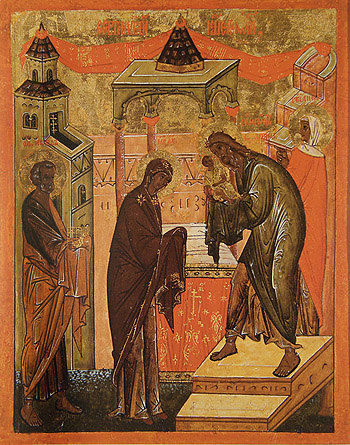
THE MEETING OF OUR LORD GOD AND SAVIOR JESUS CHRIST
09:20 PM
The event of the meeting, in other words the meeting of the Old Testament piety with the holiness of Christ, the Church remembers every evening, “at the setting of the sun”, repeating the words of St. Symeon the Receiver of God: “Now lettest Thou Thy servant depart in peace, Oh Master, according to Thy word, for mine eyes have seen Thy salvation…” (St. Luke 2:28-32).
“Sanctify unto Me all the firstborn, whatsoever openeth the womb among the children of Israel, both of man and of beast,” was commanded by the Lord through the prophet Moses. “and all the firstborn of man among thy children shalt thou redeem” (Exodus 13:2, 13). When the service before the tabernacle of the covenant was given to the tribe of Levi, in other words to the Levites, a special redemption was set for the firstborn (Leviticus 12:6-8).
Thus, the Redeemer of the entire race of men was brought into the Jerusalem temple for redemption, while the More Honorable than the Cherubim, His Most Pure Mother had to undergo the ancient custom of the cleansing of the one who gave birth, who for the duration of the first forty days after the birth of a male child was considered unclean: in these days she was forbidden from touching holy objects, climbing unto the Temple Mount and taking part in the public worship (the unclean days of those, who gave birth to infant girls, altogether lasted for sixty six days (Leviticus 12:2-5). So it turns out that the Meeting is also, in a way, a Feast of the Lord’s humility.
According to ancient tradition, repeated in the works of Ss. Gregory of Nyssa, Cyril of Alexandria, and Andrew of Crete, the high priest (believed to be St. Zacharaiah – father of St. John the Baptist) by grace, contrary to the old law, led the Theotokos with the Infant from the place appointed to unclean women to the place where only the virgins stood, leaving without heed the rebukes of the scribes and Pharisees.
“But when the fulness of time was come, God sent forth His Son, made of woman, made under the law, to redeem them that were under the law,” writes of this the Apostle Paul (Galatians 4:4-5). “And when they had performed all things according to the law of the Lord, they returned into Galilee, to their own city Nazareth” (St. Luke 2:39).
Corresponding with this indication of the Evangelist Luke, who made a special effort to follow the chronological continuity in his account of the Good News, one can admit that the Holy Family fled into Egypt not directly from Bethlehem, but from Nazareth, having spent a short time there. In reality, the events of the gospel history – prior to the flight into Egypt – look this way: Nativity in Bethlehem of Judea; Circumcision of the Lord on the eighth day (in the same place); visit to the Jerusalem temple on the fortieth day (Meeting); return to Bethlehem and stay there until the arrival of the magi (?); departure for Nazareth, and from there into Egypt.
Wolfgang Pax in his detailed illustrated guide to the Holy Places of Palestine “In the steps of Jesus” notes, that, “supposedly Joseph and Mary with the infant moved to a small stone building; we don’t know whether it was built by the betrothed himself (he was a builder because of his occupation), or it belonged to some of his relatives. Now, nothing is left of it” (I cite the 1970 edition published in English).
Traditions about some home of the Holy Family in Bethlehem, more specifically in its immediate surroundings, to name it, in Beit Jala, are kept to this day among the Christians of Palestine.
Yet, according to the Lives of the Saints, the Theotokos during the forty days lived in the same cave, where the Savior was born. There is also a tradition to relate the arrival of the magi to the very first days after the Nativity: that is why it is said that the cleansing sacrifice of the Ever-Virgin – two doves (St. Luke 2:24) – was so small, because from the gold, brought as a gift by the magi, she left herself the smallest part, having given the rest away to the poor. Let us not forget, at the same time, that king Herod “sent forth, and slew all the children that were in Bethlehem, and in all the coasts thereof, from two years old and under” (St. Matthew 2:16), but the Lord was not among them: notified by the Angel, the Holy Family left the city. How did that happen? It turns out that, by the will of God, the murderers missed Christ: Joseph and Mary with the Divine Infant were already in Jerusalem, when Herod’s special forces entered Bethlehem…
“…the Holy Spirit was upon him,” says the Gospel about the elder Symeon, who came out to meet Christ (St. Luke 2:25). “Like the other old testament faithful, Symeon prepared to die with the faith in the fulfillment of the promises of God, but the Holy Spirit revealed to him that his was a much better lot” (Archbishop Nikodim. Soul-benefitting Reading, part 1,. 1861). Let us recall that this better lot was the punishment for unbelief: according to tradition, Symeon, who lived to the most profound old age, doubted the truth of Isaiah’s prophecy about the Virgin, Who shall give birth to a Son (Isaiah 7:14). As one of the creators of the Septuagint (“the translation of the seventy”), preparing the Greek text of the Bible for the king Ptolemeus Philadelphus, the young zealous scribe Symeon already wanted to change the unusual words, which he had to translate into Greek, but the Angel stayed his hand, having cried: “Believe in what is written! You shall see the fulfillment of these words and shall not die until you see their fulfillment.”
The feast of the Meeting, according to the rubrics, is considered to be one of the Theotokos, and is even sometimes called the Meeting of the Most Holy Theotokos; however, at the same time, some of the details of the service of the Meeting are the same as for the feasts of the Lord. This “dual nature of the feast, the joy of the Meeting and the sorrow of the Passion” (Monk Gregory Kroug, Thoughts about the Icon, 1969) is reflected in the prophecy of the holy elder Symeon, addressed to the Infant and to His Mother, and to the entire created world, which is “broken upon Christ,” is divided in two; is cut asunder by the same weapon (specifically – by the sword), that – according to the words of Symeon the Receiver of God – will pierce the soul of the Mother of God, in order that “the thoughts of the many hearts” may be revealed (St. Luke 2:35). Let us also note, that this is the last time until the very crucifixion, when that of Mary and that of Jesus is tied into one in the historical narrative of the Gospel, when the Mother is still trying to protect Her Son, to hold Him with her hands. Therefore, the Meeting contains within itself the Gospel of the Passion: on the icon of the feast “the Mother of God as though carries the Savior, but the Savior is no longer in her hands, He is held by Symeon the Receiver of God, and the throne, depicted in the very center of the icon, between the Mother of God and Christ in the hands of Symeon, creates as though the impassable wall” (monk Gregory Kroug).
Nothing can be changed. The redemptive sacrifice must be offered.
Child, what didst Thou do with us? – Mary will quietly ask her Son, Whom She looked for a long time in the noisy porticos of the Jerusalem temple. – Behold, Thy father and I looked for Thee with great sorrow.
Why did you need to look for Me? – the twelve year old Child will answer. – Or, did ye not know that I must be about My Father’s business? (St. Luke 2:48-49)
The feast of the Meeting in its essence sets boundaries. Our ancestors very well recognized this characteristic, saying: “for the Meeting the sun turns for the summer, and the winter turns for the frost.”
-
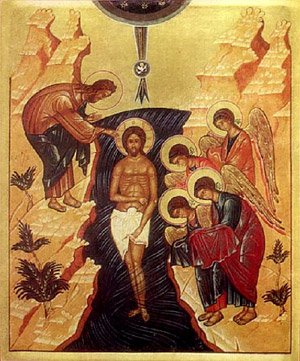
THE HOLY THEOPHANY (BAPTISM) OF OUR LORD GOD AND SAVIOR JESUS CHRIST
05:34 PM
“The significance of Jordan cannot be overestimated, for the historical role of the river goes beyond all rational calculations,” wrote the famous archeologist Nelson Gluck about this muddy, somber, and in places dangerous river.
According to the Old Testament book of Joshua the son of Nun, stones were put into the waters of the Jordan in memory of the miraculous crossing of the Israelites across the river as though it were dry land; blessed Jerome, who lived in the Holy Land in the ninth century, testifies that these stones were still visible during his time. It was there, near Bethabara (which means ford), that the last Prophet of the passing, Old Testament, was baptizing the people. Pointing to the white slippery boulders, solemnly, he said:
“And think not to say within yourselves, We have Abraham to our father: for I say unto you, that God is able of these stones to raise up children unto Abraham” (Matthew 3:9).
However, according to other commentaries, the Baptist, by stones, meant the gentiles, yet it is difficult to understand where, in the crowd surrounding the prophet, could be found any noticeable number of those, who did not keep the law of Moses. One way, or another, yet the pilgrims used to carry away, and they do it to this day, from the holy river broken pieces of stone, filed and rounded by the streams of Jordan’s waters; and are not all of us made sons unto Abraham out of them?
“Water is the beginning of the world, Jordan is the beginning of the Gospel”, says St. Cyril of Jerusalem. As in the second verse of the book of Genesis, on the day of the Baptism, the Spirit of God once again was hovering over the water, over the wet brown (“which reached to extremities” – church historian Nicephoras Callistos) hair of Christ, and God the Father, Himself, the Lord of Hosts, in the expression of one of the contemporary church author, did not hold back and exclaimed: “This is My beloved Son, in Whom I am well pleased!”
In the year 28, having come to Bethabara, which was located a few kilometers away from the Dead Sea, the Lord knew “what He was doing, and what He was doing it for” (Prot. A.V. Gorskiy). “Jesus Christ asks for baptism for Himself, as a symbol of the repentance for the sins of mankind,” we read in one of the festive homilies. However, is it correct here, is it applicable here, the very meaning of the symbol?
“He comes to the waters of the Jordan in order, to wash the sins of publicans and sinners, says St. John Chrysostom, oh, the new wonder! Oh, the unspeakable grace! Christ completes the feat, yet I receive the honor; He struggles with the devil, yet I am the victor; He is baptized, yet the defilement is removed from me…”
And the Forerunner, filled with the prophetic spirit, knows that now, before his eyes, the Lamb of God takes upon Himself the sins of the world, and, as a man, he tries to halt Him:
“I must be baptized by Thee, and comest Thou to me?!” (Matthew 3:14)
Three years later, His Apostle Peter asked Him in the same way:
“Lord! Dost Thou wash my feet?” (John 13:6)
The answer was similar: “Suffer it to be so now: for thus it becometh us to fulfil all righteousness.” Thus did the Lord answer John the Forerunner. And here is the answer for Peter: “What I do thou knowest not now; but thou shalt know hereafter” (John 13:7).
John agrees right away, the disciple first argues, but in both cases the Gospel ministry of Christ is fulfilled to the end.
“…St. Paisios the Great prayed for his disciple, who renounced Christ, and when he was praying, the Lord appeared to him and says: “Paisios, for whom are you praying, he renounced me?” Yet the saint continued to pity his disciple and then the Lord said to him:
“Paisios, you became like unto Me through love.”
Thus is peace acquired and apart from this, there is no other way” (St. Silouan of Athos. About peace).
Christ, in the words of the same St. Silouan, was “sorrowful for the people to such an extent,” that He went to the death on the cross for their sake.
Here, on the Jordan was the beginning of the way of the cross, the way that leads to Golgotha and Resurrection.
“The voice of the Lord upon the waters is crying out, saying: come, receive ye all the Spirit of wisdom, the Spirit of knowledge, the Spirit of the fear of God, of Christ manifest. Today the nature of water is sanctified, and the Jordan is parted, and it turns the streams of its waters, beholding the Master being baptized” (from the service of the feast).
-
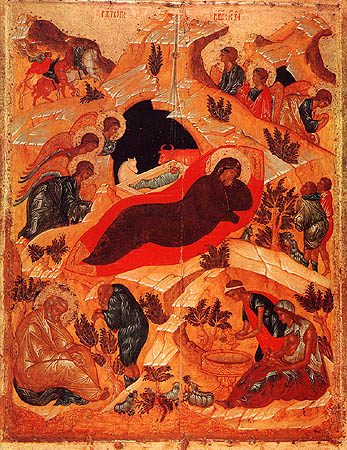
Nativity epistle of His Grace, Bishop Gabriel
11:40 AM
Dear in the Lord, fathers, brothers and sisters!
The spiritual significance of the events of the Gospel history, one way or another connected with the birth into the world in the flesh of our Lord, God and Savior Jesus Christ, is truly precious for the pious Christian conscience.
“As God of the world and Father of compassions, Thou hast sent to us Thine Angel of great Council, Who granteth us peace. Wherefore, guided to the light of knowledge divine, and rising at dawn out of the night, we glorify Thee, Who lovest mankind,” is sung in the 5th ode of the Nativity canon.
We see, that long before the coming of the Messiah-Christ, He was already called “Angel of great Council of God”. And in these days of the solemnities of Nativity He, Christ-Child, having become Man, came to earth, to us – people, granting us peace. What does it mean, to have spiritual peace? It means humbly to accept the course of our life, including sorrows and injustices. One cannot live without them, yet in the eyes of true followers of Christ, they – at least on the day of the Feast – seem to be too insignificant to disturb the spiritual peace of those, who came to know that today with us is the Angel of great Council, “Who brought the very heaven into the cave in Bethlehem”, – according to the words of the Most Blessed Metropolitan Anthony, founder of our Church Abroad.
Every little detail of the Nativity events is full of salvific meaning. Let us recall how the righteous Joseph the Betrothed met the news that the Virgin Mary committed to his care was found to be with child. From the words of the canon of Nativity with learn that the meek elder was overcome by the “tempest of doubting thoughts.” Separately, we should note that he was not yet granted the full comprehension of exactly what events his was a witness and participant. The Betrothed remained humble, meek and fully submitted to the will of God, unwaveringly believing in its goodness and justice. In response to his meekness and humility, the Lord, wishing to comfort and strengthen His faithful servant, sent to him in a dream His Angel, who revealed to him the greatest mystery of the creation of the world: “Joseph, thou son of David, fear not to take unto thee Mary thy wife: for that which is conceived in her is of the Holy Spirit.” (Matthew 1:20).
How often all of us are faced with temptations, which stir us up, incline us toward wrath and irritability. Yet let us not forget that it is not given unto us to understand the true meaning of what is happening in the world “according to our own desires.” Let us ask of the Lord meekness, humility and kindness. Maybe the merciful Lord will see our faithfulness and efforts, and will grant us the understanding of the salvific meaning of the events, which cause us alarm and confusion. “Bow before the manger of beasts, through which you, who became irrational, were nourished by the Word,” says St. Ephraim the Syrian, and then our souls will be filled peace and joy in Christ.
CHRIST IS BORN! GLORIFY HIM!
GABRIEL
Bishop of Montreal & CanadaNativity of Christ, 2011
-
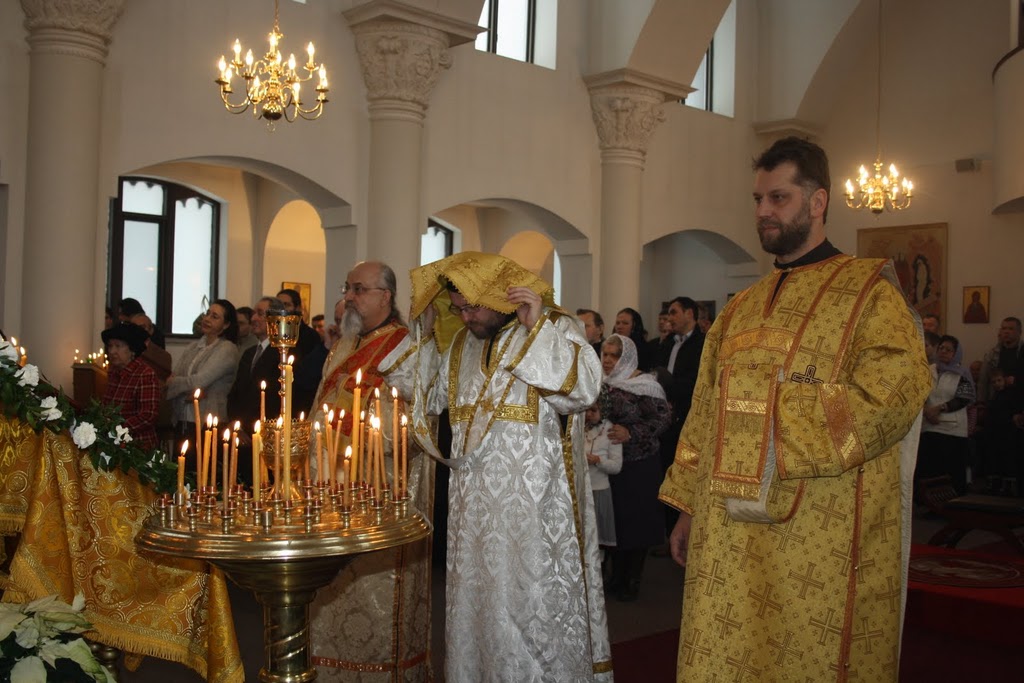
Parish feast in Montreal
09:06 AM
This year, the parish feast of St. Nicholas’ Cathedral in Montreal, celebrated on “Winter St. Nicholas”, December 6/19, fell on Sunday. Guests from the other parishes of our diocese arrived for the all-night vigil on Saturday: for Polyeleos, His Grace, Gabriel, Bishop of Montreal and Canada, was followed not only by the cathedral clergy: the sacristan, protopriest George Lagodich and priest Michael Metni, but also by priest Viatcheslav Davidenko (Trinity cathedral, Toronto, Ontario) and priest Alexey Pjawka (Protection Memorial church, Ottawa, Ontario).
His Grace, Vladyka Gabriel served the Divine Liturgy, along with the above mentioned clergy, together with protodeacon Vasili Milonow, cathedral deacon Boris Sidorenko, and deacon Eugene Schukin, who was ordained to the priesthood after the Great Entrance. Fr. Eugene will have the task of caring for the recently established community of St. Tikhon, the Patriarch of Moscow, the Confessor, in Kitchener, Ontario.
The services were held with a large number of people attending: there were not only local parishioners, but also those, who came to the cathedral in order to share the feast with the Montreal parishioners. The cathedral choir, under the direction of Michael Kreiger-Voinovsky, sang beautifully and movingly.
Priest Viatcheslav Davidenko preached a sermon, and after the dismissal, Vladyka Gabriel address the flock with his archpastoral greeting. After the prayer service before the church icon with the relics of St. Nicholas, and after the chanting of many years, all present were invited to a meal, prepared by the cathedral sisterhood, which is long famous for its hospitality.
Here are some photos from the event in Montreal.
-
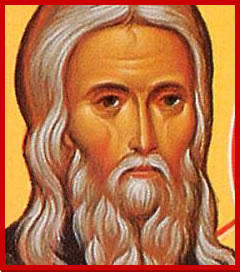
St. Herman’s youth conference
08:55 PM
ENCYCLICAL
To All the Reverend Rectors of the Montreal & Canadian Diocese
DIRECTIVE
This year, the St Herman’s Youth conference will be held, with God’s help, at the Holy Trinity Monastery, Jordanville, USA. The St Herman’s youth conference is now in it’s 30th year and continues it’s mission to provide a rare opportunity for all of our Orthodox youth to meet together, to become acquainted, to participate in group discussions and to listen to lectures of a purely Orthodox character, and finally and most importantly, to prepare for and receive communion of the Holy Mysteries of Christ on the feastday of St Herman, 12/25 December.
In connection with this, I urgently request that all the reverend rectors take up a special collection on Sunday, December 6/19 of this year in our parishes at the end of the Divine Liturgy to help defray the costs of organizing this conference. I would also ask that this be announced from the amvon prior to the collection taking place.
The St Herman’s committee which is undertaking the organization of the conference is working very hard to contain the costs of attending these conference to a minimum. As always, the outlays for food and lodging are the highest. For this reason we are appealing to each parish to make this conference accessible to as many of our Orthodox youth as possible.
The funds collected will help to cover the expenses of the conference and will also be used to make it possible for the St Herman’s organizing committee to assist young people from families of limited means.
You may ask why support a conference in the USA when we have our own Canadian needs? To this I will answer, last year when the conference was in Montreal we received most of our support from the USA parishes. We need to contribute generously to help as many of our Canadian youth to attend the conference this year.
I thank you in advance for your support. Please do not forget that our youth is our future. We must support it!
Please send cheques to:
St. Herman’s Youth Conference
c/o Rev. George Lagodich
6738 32 Ave
Montreal, QC H1T 3C9Gabriel
Bishop of Montreal and Canada
November 22/December 5, 2010
-
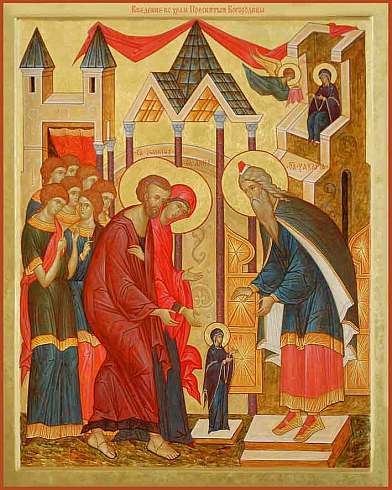
Entry into the temple of our Most Holy Lady the Theotokos and Ever-Virgin Mary
08:54 PM
Particular details, reflected in the feast – on the the Great Twelve Feasts – of the Entry into the Temple of the young Jerusalem Maiden Maria – the Living Temple, destined to be the New House of God (similarly as also the circumstances of the Nativity of the Theotokos) – we find in one of the ancient memorials of faith of the Palestinian christians: in the so called Protevangelium of James (the Story of James). The study of this book, it reflected in itself the Holy Tradition, confirms that the veneration of the Mother of God was established in the early Church in no way later than the beginning of the second century.
“…The child reached the age of two, and Joachim said: “Take Her into the Temple of the Lord, as the fulfillment of the promise, which we took upon ourselves and must fulfill; in order for the Lord not to requite it from us, and that our gift would not become unacceptable to Him.” And Anna said: “Let us wait for the third year, so as not to tarry the Child with her father and mother.” And when the Child was three years old, Joachim said: “call for the pure virgin Hebrew daughters and give each of them a lamp, and let them light them, and let not the Child turn back, so that Her heart would not turn away from the House of God.” And they did so until they entered the Temple. And the priest met Her, and kissed Her, and blessed Her, saying: “The Lord God will magnify Thy name in all generations; in Thee, in the end of times, the Lord will proclaim the deliverance of the children of Israel.” (Protevangelium of James, 7:1-6; as published by Collins, London, 1980).
Further, the Story of James tells that the young Mary was led to the third step of the temple altar “and the mercy of God was poured out upon Her, and the Child danced for joy”, – on account of the unspeakable joy of meeting with the Spirit of the Lord, – in the same way as, about a decade and a half later, the child rejoiced and leapt in the womb of Elizabeth, the mother of John the Baptist, when the Theotokos and Ever-Virgin Mary, the Temple Not Made with Hands, entered the house of Zacharias and Elizabeth, the parents of the future Forerunner of the Lord (Luke 1:39-45).
Pious tradition adds that the priest, whose duty it was to serve at the time, (some sources state that it was namely Zacharias) by the revelation of God led the three year old Mary into the Holy of Holies of the Jerusalem Temple; this caused not only the people to marvel, but also the Powers of Heaven: “the angels wondered seeing the entry of the Most Pure One: how the Virgin entered the Holy of Holies with glory”. One should remember, the tradition states that the apostle James, the brother of the Lord, to whom the Story of James is ascribed, had the right to see the Holy of Holies.
The maiden Mary was raised at the Jerusalem Temple “as a dove and received food from the hands of angels” – meanwhile, the historical fact that She could have been left to live on holy mount Moriah is supported even by non-christian sources. It is known that there were built thirty three story “stone houses, spacious and beautiful… These houses had rooms for various persons: the virgins lived separately, until the time of consecration for the services to God” (I cite: S.V. Bulgakov. Handbook for the sacred church ministers. Kharkov. 1900).
It is difficult to say when exactly the feast of the Entry into the Temple became a part of the circle of the divine services of the Twelve Feasts. It is only known that the beginning of the celebration is connected with the most famous Jerusalem building of the byzantine times: the Basilica of the Most Holy Theotokos, which was erected on the Temple mount by emperor Justinian in the sixth century A.D. The ruins of this basilica, known by the name of “nea” (new) were found during the excavations in Jerusalem in the first half of the 70s. It is possible that the fourth century historian Procopius mentions “Nea”. Among other things, in the last century, Russian church writer and historian Avraam Sergeyevich Norov talked in the Holy City with the Palestinian Christians, “who to this day point to the Church of the Entry of the Theotokos, which used to be in ancient times, and attribute its building to empress Helena” (See “Travel in the Holy Land in 1835”.).
The consecration of the basilica “Nea” took place in 548 – and gradually, the annual church feast got tied with the corresponding narrative of the Story of James. Nonetheless, even one hundred years after the consecration, the ever-memorable Patriarch of Jerusalem Sophronios, speaking in one of his homilies about the life of the young Mary in the Temple, does not mention the church feast of Her Entry.
In the 638, “Nea” was converted into a mosque. The church feast was no longer celebrated. But specifically from that time, beginning with the second half of the seventh century, the service for the Entry of the Most Holy Theotokos into the Temple began to gain the features of an independent feast.
It is said that the feast came to Constantinople from Jerusalem by the efforts of St. Andrew of Crete, although there is no specific proof of that. In any case, it was specifically at that time that the Patriarch of Constantinople, Herman I, dedicated two homilies to the Entry. It was said in them that the festive Entry services appeared very recently. The homilies of Patriarch Herman are dated in the beginning of the eighth century, and in the next century, stichera of the feast, which are sung to this day, were written by St. Gregory of Nicomedia.
It is curious that the Greek Orthodox Encyclopedia mentions, without any details, some depiction of the young Theotokos, praying on the Temple mount, the depiction being located somewhere in Rome; it is dated in the fifth century.
“The Virgin openly appears in the temple of God and proclaims Christ unto all”, – is said in the troparion of the Entry. “And the entire house of Israel loved Her”, – is said in the Story of James. Yet this is only the preparation for the incarnation of Christ, and today She, the three year old, without turning back, with wondrous ease runs up the high steps to the very altar, – and from this day of the Entry the Church, on the journey to meet the Nativity of Christ, begins to sing: “Christ is born, glorify…”.
-
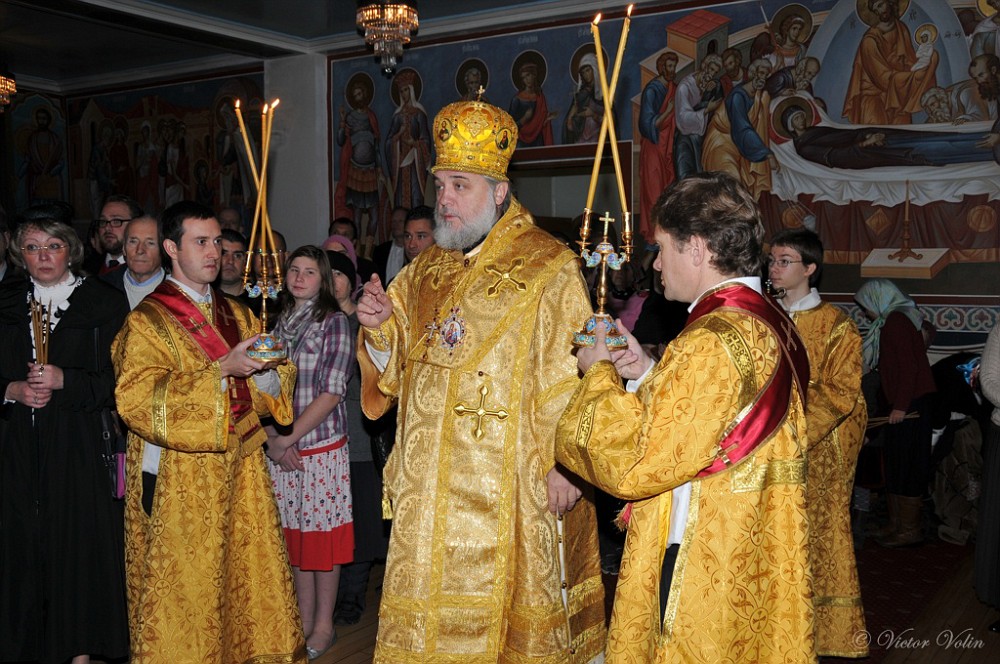
Celebration of the 90th anniversary of the Russian Church Abroad in the Canadian Diocese
10:27 PM
The 2010 marks the 90th anniversary of the canonical founding of the Russian Orthodox Church Abroad. This significant event in Russian history was solemnly celebrated in the Canadian Diocese.
With the blessing of His Grace, Gabriel, Bishop of Montreal and Canada, it was decided to hold the celebration on November 7/20 and 8/21, at the Holy Trinity church in Toronto, Ontario, – the largest parish of the Church Abroad. The date for the celebration was not chosen by accident. It was during these days in 1920, aboard the ship “Great Prince Alexander Mikhailovich” (one of those used by the Russian exiles leaving Crimea), near the shore of Istanbul-Constantinople, then in the city itself, that the first sessions of the Temporary Highest Church Administration in the South of Russia took place under the presidency of the Most Blessed Metropolitan Anthony (Khrapovitsky), which gave the beginning to the existence of the Russian Church beyond the borders of our Fatherland.
The first session took place on November 6/19, 1920, then, a day later, on November 7/20, of the same year, the well-known ukaz number 362 of St. Tikhon, the Patriarch of Moscow, the Holy Synod and the Highest Church Council of the Russian Church, that, in particular, stated: “2. In the event that a diocese… will be unable to communicate with the HCA (Highest Church Administration), or the HCA itself, headed by the Patriarch for some reason will cease its activity, the diocesan hierarch must immediately contact the hierarchs from the neighboring dioceses in order to organize the Highest Church Administration… 3. The care for organizing the “Highest Church Administration, for those… in circumstances described in paragraph 2 …is the indispensable duty of the highest ranking hierarch in the said group.”
Nine decades later, on exactly the same day, in the parish hall of the Holy Trinity cathedral in Toronto, a youth conference began, which also opened the Diocesan solemnities. In his opening remarks, His Grace, Vladyka Gabriel, in particular, touched upon those numerous difficulties, experienced by the bearers of the Orthodox worldview in contemporary setting, especially for the Russian people outside of Russia. Vladyka noted that in our times, when maybe even the gadarene demoniac, whose story is related in Holy Scripture, would be considered if not healthy, then at least only in need of a psychotherapist, people do not notice the influence of the evil spirits, although their activity now is seen almost more than in the times of the earthly life of the Lord Jesus Christ. He especially underscored that one may find salvation from the demonic activity of this world exclusively within the fold of the Church, and that the founding, by the will of God, of the Russian Church Abroad allowed our immigration to preserve both our spiritual and Russian identity.
After a lively discussion of Vladyka’s opening remarks, participants in the conference were offered a presentation prepared by the choir conductor G.A. Skok. His presentation offered a detailed look at the history of the Canadian Diocese of the Russian Church Abroad.
The conference was concluded by Protopriest Vladimir Morin, rector of the church of Christ the Savior in London, Ontario, talking about the first in the last 90 years visit of the wonderworking icon of the Mother of God of “Kursk-Root” to the Fatherland. Protopriest Vladimir was a member of the delegation that took the Directress of the Russian Diaspora on the trip to Russia. This trip became a great spiritual event, in some way a crowning of the grace-filled process of the reestablishment of the unity of the Russian Church. He illustrated his story with a documentary film about both the wonderworking “Kursk” icon of the Theotokos and about the way, in which the regenerating Orthodox Russia met this holy icon.
At 7:00 PM, all-night vigil began; it went with a special pious inspiration, assisted in this greatly by the tender singing of the cathedral choir under the guidance of G.A. Skok. During the polyeleos, Vladyka Gabriel was serving with the rector of the Trinity cathedral, mitered protopriest Vladimir Malchenko, mitered protopriest Sergey Rasskazovsky (Patriarchal Representation, Parish of St. Tikhon, Patriarch of Moscow), who came especially for the feast, protopriests Vladimir Morin and Michael Lyuboshchinskiy (Protection church, Hamilton, Ontario), priests Viatcheslav Davidenko (Toronto) and Alexey Pjawka (Protection Memorial church, Ottawa, Ontario), along with protodeacon Vasili Milonow, and deacons Alexander Morin, Ilia Grozdanov and Eugene Schukin.
For the Sunday Liturgy, which took place with a great gathering of the faithful (more then eight hundred), Relics of the Baptizer of Russia, Holy Equal-of-the-Apostles Great Prince Vladimir, being in Canada with the blessing of His Eminence, Vladimir, Metropolitan of Kiev, were brought to the Trinity cathedral.
The above mentioned clergy of the Russian Church Abroad, joined by protopriest George Lagodich (St. Nicholas Cathedral, Montreal, Quebec), concelebrated with Vladyka Gabriel.
On the 21st of November, the day when the Church celebrates the synaxis of the holy Archangel Michael and all the bodiless hosts, was the 25th anniversary of the blessed repose of the ever-memorable Metropolitan Philaret (Voznesensky), third in the succession of the First Hierarchs of the Russian Orthodox Church Abroad. This great man of prayer was commemorated in the entire Canadian Diocese, in accordance with the ukaze of His Grace, Bishop Gabriel, and at the Trinity cathedral, where the 90th anniversary of the Church Abroad he once led was being celebrated, Memory Eternal was sung after dismissal. Memory Eternal was chanted for all the ever-memorable First Hierarchs of ROCOR and for all the Russian people, who gave their lives for the faith, for the tsar, and for the fatherland, for all who fell asleep in diaspora and for all who fell in fratricidal war. A prayer service to Holy Equal-of-the-Apostles Great Prince Vladimir was served and Many Years was intoned for His Holiness, Patriarch Kirill of Moscow and all Russia, the current First Hierarch of the Russian Church Abroad, Metropolitan Hilarion, all hierarchs of ROCOR, and also for the rector, clergy, and many parishioners of Trinity cathedral in Toronto – the hospitable hosts, who labored much for the success of the current celebration.
At the banquet, which was attended by more than three hundred people, His Grace, Bishop Gabriel addressed all present with the words of gratitude and once again turned to the historical events, the memory of which gathered all the children of the Russian Church Abroad on that day. Let us recall, brothers and sisters, – said Vladyka, – that in the years of civil trouble and rule of the godless authorities in the Russian land, almost one and a half million people fled from its borders. Among them were notable politicians, military commanders, famous writers, philosophers, and scientists. They created political, military, and creative organizations. Already, in the first half of nineteen twenties, many publishing homes, newspapers, and magazines appeared in the diaspora. Russian political, scientific, and literary life possessed a striking richness and diversity. Yet, by the unfathomable will of God, all of it, with the passing of the short – from the historical perspective – nine decades, almost completely vanished, and in any case, took on a very humble resemblance. Conditionally speaking, only one immigrant “organization” continued to grow steadily. Despite all obstacles, difficulties, and troubles, it remained the sole organization that united within its borders everything that was called and is now called the Russian Diaspora. The entire essence of the mission of the Russian Immigration was concentrated in it. For this “organization”, as it is said in the Scripture, came to be “not of men and not according to men”. This is our Russian Church Abroad. If weren’t established by the providence of God, then the Russian Orthodox Diaspora would not have been preserved.
His Grace, Bishop Gabriel also reminded that the well-known ukaz number 362 of Patriarch Tikhon, along with the “thomos” of the Ecumenical Patriarch, the two that served as the foundation for the canonical activity of the Russian Church Abroad, was adhered to strictly. And when, by the mercy of God, the Russian Church in the Fatherland, after long sufferings, once again obtained freedom to carry on its ministry, the canonical communion between the two parts of the Russian Church in the Diaspora and in the Fatherland was reestablished. Yet, that doesn’t mean that our special ministry is fulfilled. Russian Orthodox Church Abroad was always faithful to its mission: the care for the Russian Orthodox people who for different reasons happened to be outside of Russia, and the preaching of Orthodoxy among the nations, on whose lands we carry out our ministry. In his recent interview to the magazine “Trinity heritage”, His Eminence, Metropolitan Hilarion underscored that after the reestablishment of the canonical unity of the Russian Church, these two main directions of our mission do not lessen, but rather are broadened and strengthened.
Then, there was a concert of the cathedral choir under the guidance of G.A. Skok. The wide program of the concert was grounded, if one can say so, on the historical canvas, being in a way a vocal chronicle of Russia and Russian Orthodox Diaspora. Good combination of the Church and secular songs, masterful, penetrating performance: all of it evoked a real ecstasy in the listeners.
Those present were greeted by the rector of the Trinity cathedral, protopriest Vladimir Malchenko and protopriest Sergey Rasskazovsky, rector of the Patriarchal representation in Toronto. In conclusion, reader Y.G. Miloslavsky, author of a number of articles on the history of the Russian Church Abroad, gave a small lecture. In particular, the lecturer touched upon the role that the two great hierarchs: St. Tikhon the Confessor, Patriarch of Moscow and Most Blessed Metropolitan Anthony (Khrapovitsky) played in ordering and developing the Russian Church Activity in the years of persecution. In his words, each one of them received the obedience prepared for him, and each one fulfilled it completely. St. Tikhon the Confessor, contrary to all the efforts of the antichrist’s powers, was granted – as St. John of Shanghai later said: “by the cross to hold the Russian Church on the surface of Russian life.” The ministry of Metropolitan Anthony was different: he was granted to preserve the Russian Diaspora. In actuality, only on account of the colossal, possessing no equals, authority of Metropolitan Anthony among the First Hierarchs of the Eastern Churches it was possible to continue the activity of the Highest Church Administration in the South of Russia abroad on canonical grounds.
This ministry continues to this day.
-
Missionary needs collection will take place on the first Sunday of Nativity Fast
11:02 AM
Notice
To all rectors and clergy of the Canadian Diocese.
This is to inform that, according to the decision adopted and confirmed by me at the fall Clergy gathering in Vancouver, on the first Sunday of the Nativity Fast, on November 15/28, of this year, all the parishes of our Diocese will have a special collection for outreach and missionary goals set out by the Diocese.
I ask all the rectors to say an appropriate word, addressed to parishioners, reminding them that all of us are members of the Church and thus, we are members of the Body of Christ, consequently both the sorrows and the joys of one are communicated to our other brothers and sisters.
It is not a secret that the financial state of our Diocese suffered greatly on account of troubles brought upon us and today, we cover our essential needs with difficulty. Yet the outreach and missionary activity may not and should not be neglected, because it is the foundation of the ministry of the Church.
Gabriel
Bishop of Montreal and Canada
November 2/15, 2010
-
His Grace Bishop Gabriel visited Calgary (Alberta)
12:54 PM
On Saturday, October 22, 2010, His Grace, Gabriel, Bishop of Montreal and Canada, accompanied by deacon Alexander Morin, arrived in Calgary (Alberta) from Vancouver (British Columbia). The church of All Saints, here, celebrated its 80th anniversary. According to the parish records, the first time the mystery of baptism was performed on October 12th, 1930. Initially, the services were held in a Protestant church, but in 1932, after the ever-memorable Archbishop Joasaph (Skorodoumov) arrived in Canada from Yogoslavia, the parish began the building of its own church. The building project was completed in 1934 and the church was consecrated by Vladyka Joasaph (to note, the 80th anniversary of the consecration of Vladyka, who became known as the enlightener of Canada, to the episcopate was recently solemnly celebrated in Montreal, with the Very Most Reverend Metropolitan Hilarion, First Hierarch of the Russian Church Abroad, attending.
The feast for the parishioners of the church of All Saints was augmented due to the fact that the 25th anniversary of the ordination of its rector – Protopriest George Primak, who was given a Diocesan gramota to mark the occasion, fell on the same date. Next day, Sunday, October 23rd, with a large number of the faithful attending, His Grace, Bishop Gabriel, served the Hierarchical Divine Liturgy.